Compare Group 24, Group 27 And Group 31 LiFePO4 Batteries
Find the right lithium battery for your RV by comparing enclosure dimensions, capacity options, terminal positions, charging compatibility and Smart BMS requirements.
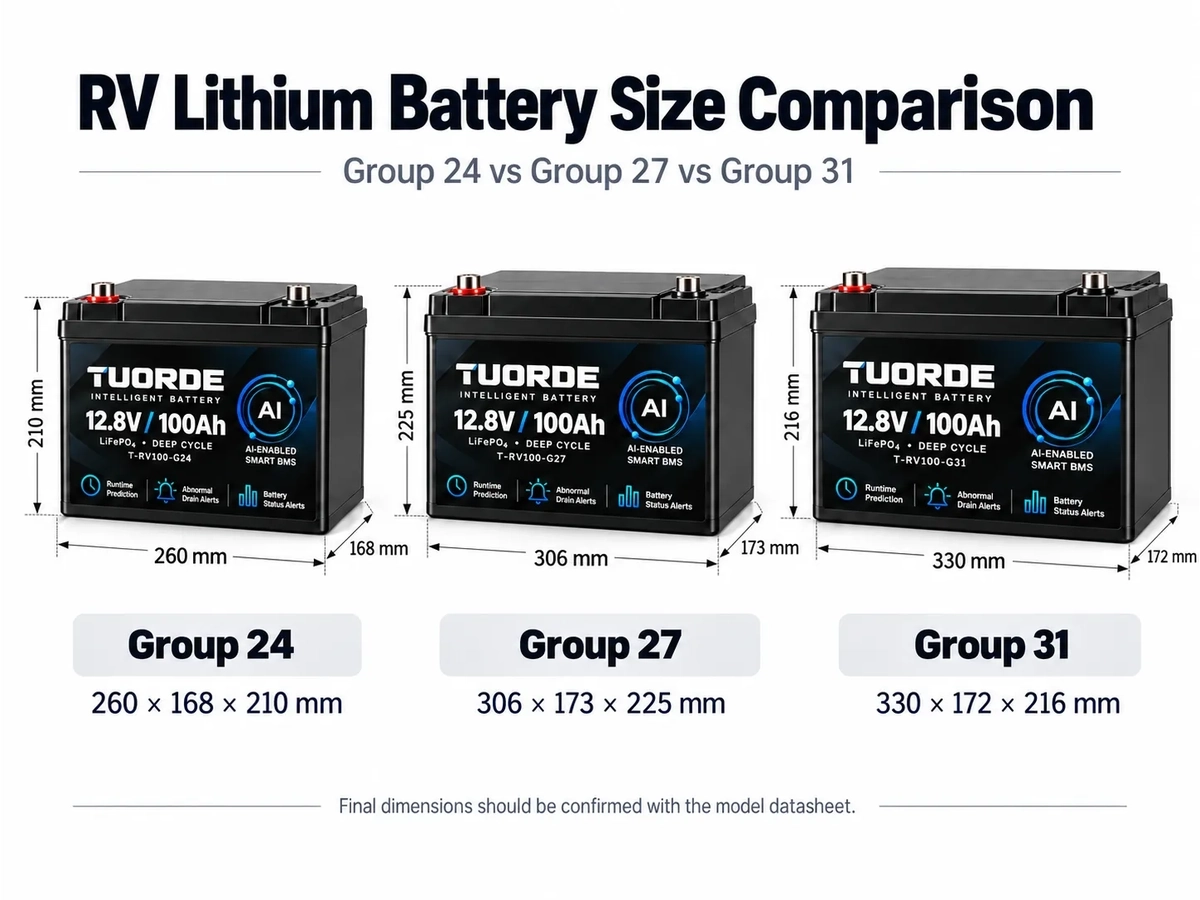
Dimensions shown apply to the illustrated housings. Confirm the selected model’s approved mechanical drawing, terminal layout and installation clearance before ordering.
GROUP 24
Compact Installation
GROUP 27
Balanced RV Options
GROUP 31
Extended Platform Options
Application positioning only. Group size does not establish a capacity ranking.
02 / COMPARE THE PLATFORMS
Group 24 vs Group 27 vs Group 31 Lithium Battery Comparison
Battery group size is a starting point for installation fit. Actual battery dimensions, capacity, terminal arrangement and electrical specifications must be verified for the selected model.
RV lithium battery size chart — platform references, not interchangeable model specifications
Specification
Group 24
Group 27
Group 31
Battery platform
Group 24 LiFePO4 enclosure option
Group 27 LiFePO4 enclosure option
Group 31 LiFePO4 enclosure option
Physical dimensions Length × Width × Height
Confirm with model datasheet
Confirm with model datasheet
Confirm with model datasheet
Capacity options
100Ah configuration
100Ah / 120Ah configurations
100Ah / 120Ah configurations
Nominal voltage
12.8V
12.8V
12.8V
Nominal energy
1,280Wh at 100Ah
1,280Wh at 100Ah 1,536Wh at 120Ah
1,280Wh at 100Ah 1,536Wh at 120Ah
Battery weight
Confirm with model datasheet
Confirm with model datasheet
Confirm with model datasheet
Terminal position
Confirm with model datasheet
Confirm with model datasheet
Confirm with model datasheet
Continuous BMS discharge current
Confirm with model datasheet
Confirm with model datasheet
Confirm with model datasheet
Smart BMS communication options
Confirm with model datasheet
Confirm with model datasheet
Confirm with model datasheet
RV installation considerations
Check tray footprint, hold-downs and cable clearance.
Balance enclosure fit with the selected energy and current ratings.
Verify available tray space, terminal access and the selected electrical ratings.
Scroll horizontally on smaller screens. Nominal energy is calculated from 12.8V × rated Ah.
Compare actual products, not group-size assumptions. A Group 31 battery does not automatically have more Ah than a Group 27 battery. Dimensions, BMS current, terminal layout and communication availability remain model-specific.
03 / CHOOSE AN INSTALLATION PLATFORM
Which RV Lithium Battery Group Size Should You Choose?
Match the available installation space to your energy and current requirements, then review the appropriate platform below. Browse AI Smart RV Batteries to compare model-specific configurations.
01 — GROUP 24
Compact RV Battery Installations
Start here for space-conscious RV installations. Check tray fit, retaining hardware and terminal clearance. For a model-specific configuration example, review the 12V 100Ah Group 24 Smart LiFePO4 RV Battery.
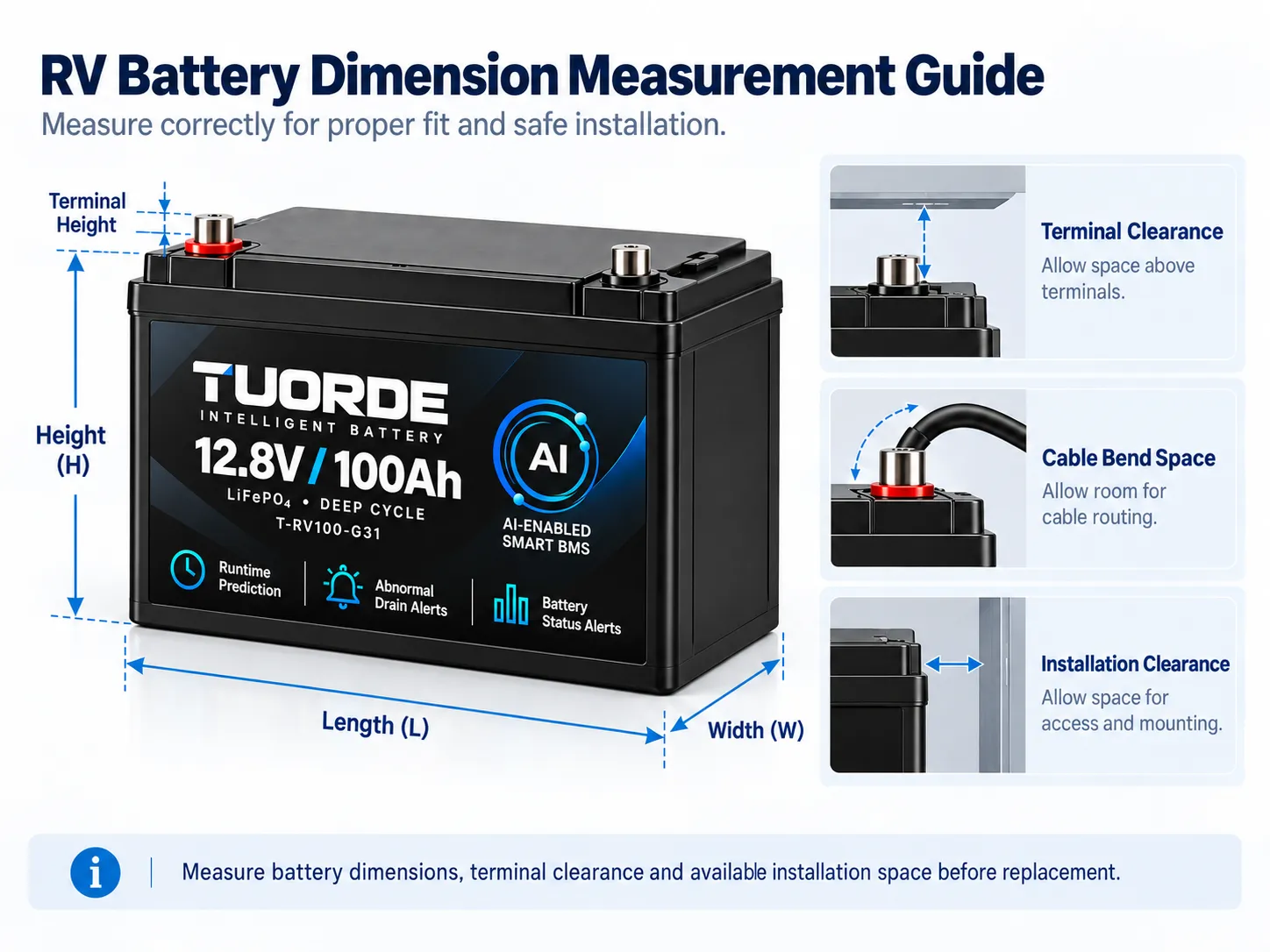
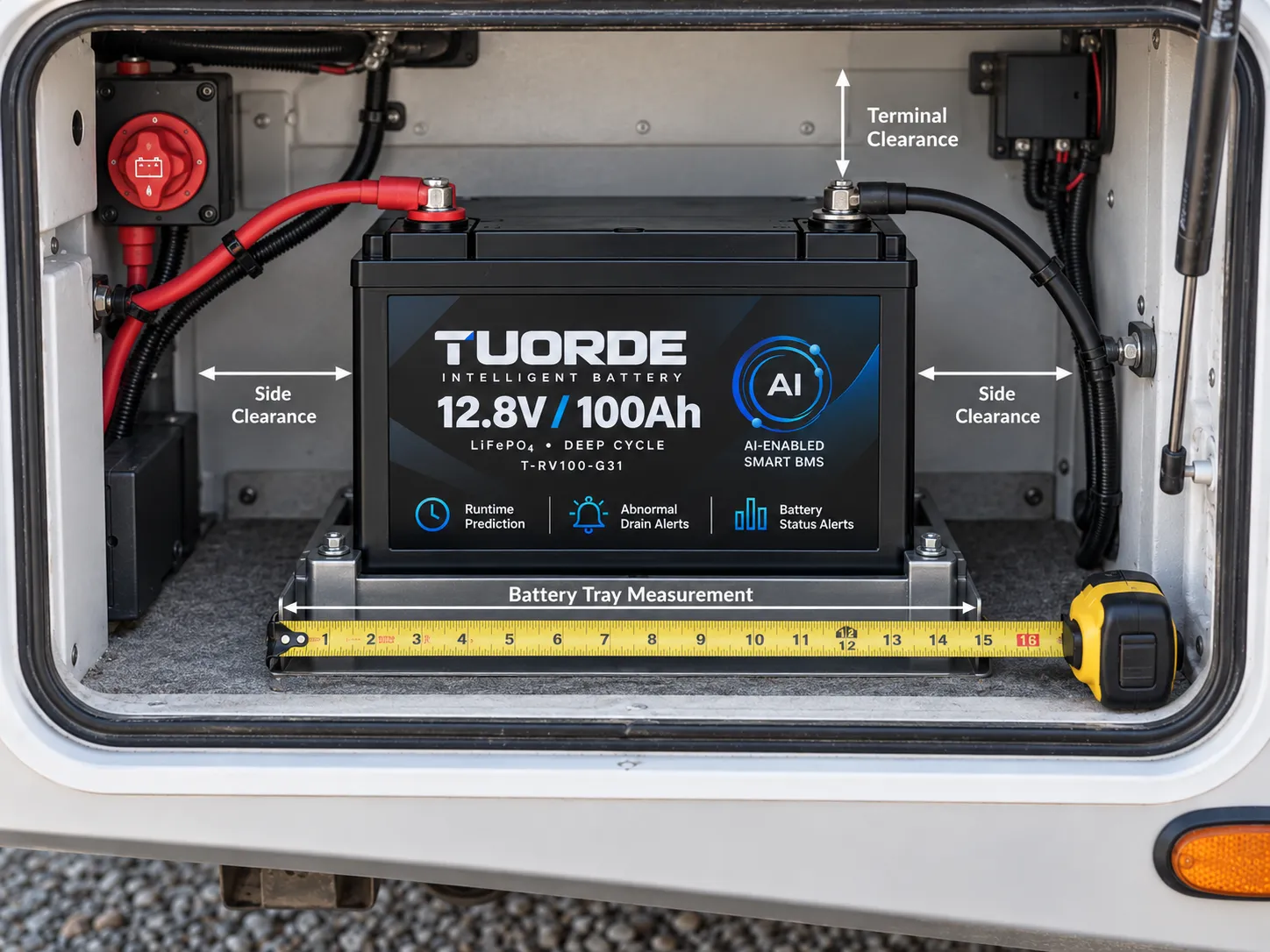
Before replacing a lead-acid battery with LiFePO4, compare the available battery compartment space with the complete mechanical drawing of the selected lithium battery.
01 — Length
Measure usable battery tray length, including housing projections and mounting restrictions.
02 — Width
Confirm battery body width, retaining straps and side clearance.
03 — Height
Allow space for battery terminals, protective covers, cable bends and the compartment lid.
04 — Terminal Position
Verify positive and negative terminal locations, polarity, cable reach and connector requirements.
05 — Installation Clearance
Check battery mounting, service access and model-specific installation requirements.
Physical fit alone does not guarantee electrical compatibility. Check charging, discharge current and system integration alongside dimensions.
05 / ENERGY, LOAD AND OPERATING TIME
Battery Capacity vs Physical Size: What Matters for RV Runtime?
Enclosure size answers “will it fit?” Capacity and power demand answer “how long can it run?” Use both checks when selecting a LiFePO4 battery for an RV.
Battery group size
A physical fit reference used to begin enclosure selection. It does not fix capacity or electrical ratings.
Battery capacity (Ah)
Rated charge capacity. Compare it at the same nominal voltage and with the stated test conditions.
Nominal voltage (V)
The voltage used to express rated battery energy. It is different from charging voltage and varies from actual operating voltage.
Nominal energy (Wh)
Nominal voltage multiplied by rated amp-hours. This is a rating calculation, not a measured runtime result.
Usable energy
The energy available within the selected battery’s operating limits and your planned reserve. Temperature, load and battery condition can affect it.
Electrical load (W)
Power demand from connected equipment. AC loads also draw energy through inverter losses.
Runtime
Operating time at the intended load. Variable appliances, cycling loads and charging inputs change the result.
NOMINAL ENERGY CALCULATION
Nominal Energy (Wh) = Nominal Voltage (V) × Capacity (Ah)
12.8V × 100Ah = 1,280Wh
12.8V × 120Ah = 1,536Wh
Illustrative nominal energy calculations, not measured usable energy or runtime guarantees.
Build a runtime estimate from your actual loads
For a steady AC load, an initial estimate is: runtime ≈ nominal energy × assumed available-energy fraction × inverter efficiency ÷ AC load power. Include other loads separately and check the selected battery’s limits.
Illustrative assumptions only: 1,280Wh × 80% available-energy budget × 90% inverter efficiency ÷ 300W ≈ 3.1 hours. The 80% budget and 90% efficiency are planning assumptions, not TUORDE product specifications. Actual runtime changes with load, temperature, battery condition and system operation.
A high-capacity battery can still be unsuitable if its BMS current rating cannot support the required power.
06 / MATCH THE ELECTRICAL RATINGS
Match BMS Current And Charging To Your RV System
Continuous current
Add simultaneous DC loads and inverter battery-side demand. Check both continuous BMS limits and allowable cable, connector and protection ratings.
Startup demand
Review inverter surge power, motor startup loads and the battery’s permitted peak current and duration. A peak rating is not a continuous rating.
Charging compatibility
Confirm LiFePO4 charging voltage, combined charging current and operating temperatures. Verify converter, solar and alternator charging equipment separately.
Parallel or series configuration
Use only arrangements approved for the selected models. Confirm battery matching, BMS behavior and wiring requirements before changing system voltage or capacity.
Illustrative current calculation: A 1,000W AC load at an assumed 12.0V battery operating voltage and 90% inverter efficiency draws about 93A before other DC loads. This is a calculation example, not a BMS recommendation. Use actual minimum operating voltage, equipment efficiency and surge requirements for final selection.
Select battery intelligence, app access and system interfaces independently of enclosure size.
AI Battery Insights
Selected configurations provide runtime estimates, abnormal drain alerts, battery health insights and One-Tap Smart Troubleshooting for battery diagnostics and guided solutions. These functions do not perform physical battery repair.
Bluetooth Monitoring
View SOC, voltage, current and temperature through a compatible mobile app.
CAN / RS485 Integration
Connect compatible RV equipment through validated communication protocols. Confirm the equipment model, firmware and interface requirements before integration.
Feature availability depends on the battery model, BMS hardware, firmware and app configuration. Explore Smart BMS & AI RV Battery Technology for supported monitoring and integration options.
08 / SPECIFY THE COMPLETE BATTERY
OEM Battery Sizing And Configuration Review
For a new RV platform or private-label program, define the installation envelope and electrical requirements together. An OEM review can cover enclosure format, terminal arrangement, capacity, BMS limits and communication interfaces.
Prepare the project inputs
Compartment drawing, mounting method and terminal clearance
System voltage, daily energy use and required autonomy
Continuous loads, inverter surge and charging sources
Operating temperatures and communication equipment
Annual volume, branding requirements and launch timeline
Review one complete configuration
Finalize the mechanical drawing, electrical datasheet and interface requirements for the same model. Avoid mixing specifications from different battery platforms. Request model-specific datasheets and mechanical drawings for engineering review.
Practical answers for comparing enclosure formats, energy ratings and RV system requirements.
What is the difference between Group 24, Group 27 and Group 31 lithium batteries?
The group designation is a starting point for physical fit. Compare the selected batteries’ dimensions, terminals, rated capacity and BMS current. A larger group reference does not guarantee higher amp-hours or longer runtime.
Does a Group 31 lithium battery always have more capacity than a Group 27 battery?
No. TUORDE Group 27 and Group 31 platform options both include 100Ah and 120Ah configurations. Compare model-specific capacity and nominal energy rather than ranking batteries by group number.
Are all lithium batteries in the same group size identical in dimensions?
No. Housing details, terminal height and mounting features can differ between models. Use the complete mechanical drawing and measure the available battery compartment before choosing a replacement.
How do I calculate nominal energy for a 12V LiFePO4 RV battery?
Multiply nominal voltage by rated capacity. A 12.8V 100Ah battery has 1,280Wh of nominal energy, while a 12.8V 120Ah battery has 1,536Wh. Usable energy and runtime depend on the selected model and operating conditions.
Can I choose an RV lithium battery using amp-hours alone?
No. Also compare voltage, physical fit, continuous and peak discharge capability, charging limits and operating temperature. For batteries with different voltages, watt-hours provide a clearer energy comparison than amp-hours alone.
What clearance should I leave around my RV lithium battery?
Follow the selected model’s installation instructions. Include space for terminals, protective covers, cable bends, retaining hardware and service access. There is no universal clearance value that fits every battery enclosure and RV compartment.
How do I match BMS current to my RV inverter?
Estimate battery-side current from inverter output power, battery voltage under load and inverter efficiency. Then verify continuous demand, startup surges, other DC loads and the selected battery’s BMS limits. The final configuration must be checked against the equipment specifications.
Do Group 24, Group 27 and Group 31 batteries use the same charging settings?
Group size does not determine charging settings. Verify the selected LiFePO4 battery’s charging voltage, current limits and temperature requirements against the converter, solar controller and alternator charging equipment.
Can TUORDE customize battery dimensions and Smart BMS communication?
TUORDE supports OEM reviews for battery housings, terminal arrangements, capacity, BMS configuration and communication options. Bluetooth, CAN and RS485 availability depends on the selected configuration and validated equipment protocols.
FROM FIT CHECK TO BATTERY SELECTION
Discuss Your RV Battery Sizing & OEM Project
Share your compartment dimensions, energy demand, inverter loads and charging equipment. TUORDE engineers can help review the right LiFePO4 battery platform and configuration.
RV Lithium Battery Size Comparison GuideA technical guide to comparing Group 24, Group 27 and Group 31 LiFePO4 battery platforms, compartment fit, nominal energy, BMS current and RV system compatibility.RV Lithium Battery Size Comparison GuideTUORDETUORDE