OEM/ODM Inquiries: +86 186 0305 9650 | ivy.xiao@tuorde.com

Truck Batteries & AI-Enabled RV Batteries | OEM/ODM & Private Label

RV Lead Acid To Lithium Battery Replacement

RV LITHIUM BATTERY UPGRADE SOLUTIONS

Upgrade Your RV Energy System With Intelligent Lithium Solutions

TUORDE helps RV manufacturers, retrofit specialists and battery distributors upgrade lead-acid house battery systems with engineered LiFePO4 batteries, Smart BMS technology and intelligent battery monitoring.

From charging compatibility and inverter integration to battery sizing and OEM customization, TUORDE develops lithium solutions for real RV power systems.

12.8V LiFePO4  |  Smart BMS  |  AI Monitoring  |  OEM / ODM

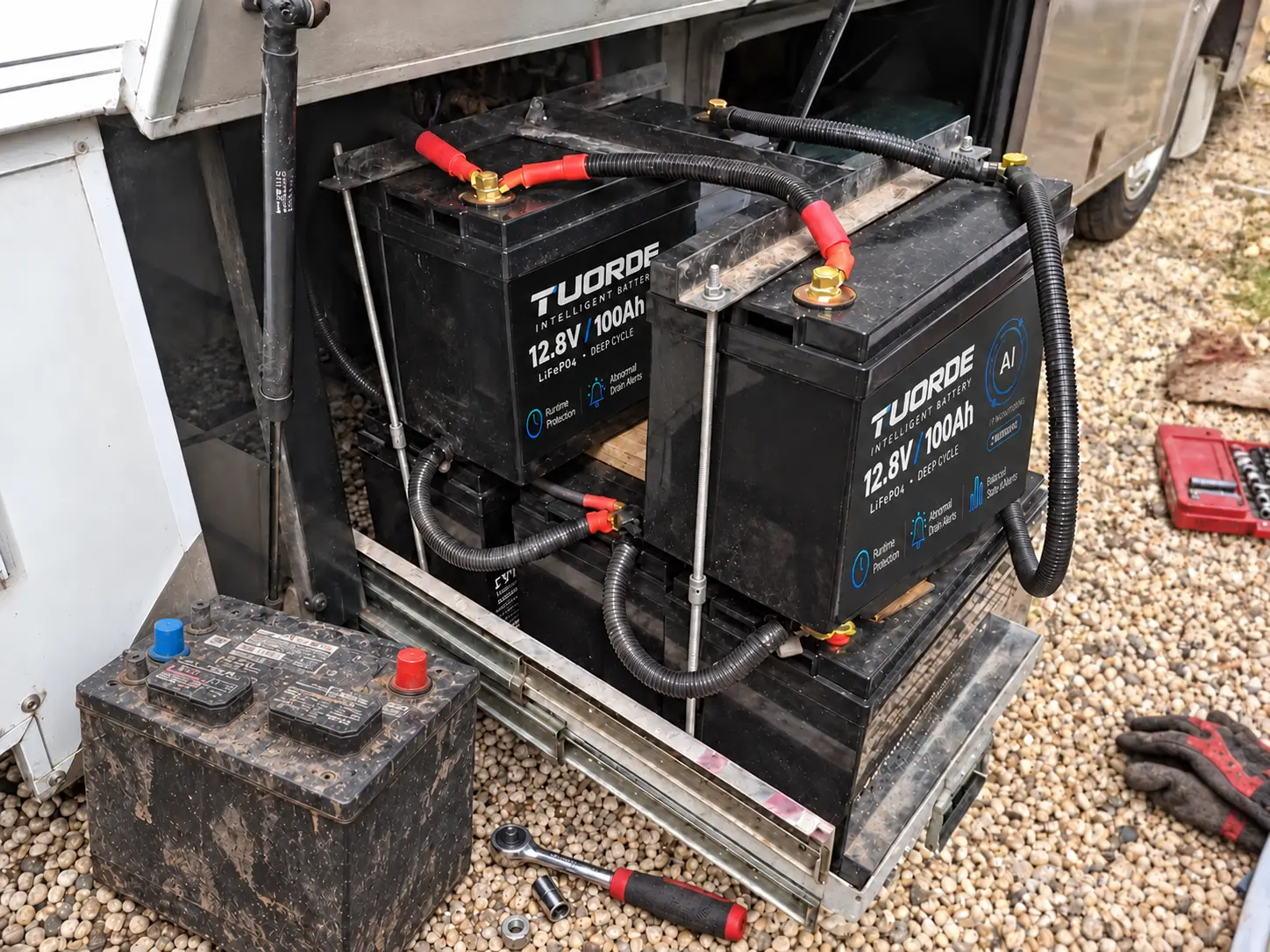
TUORDE RV lead acid to lithium battery conversion with LiFePO4 battery upgrade installation

Illustrative RV battery conversion. Electrical compatibility and installation must be verified for each project.

WHY UPGRADE

Why Upgrade RV Lead-Acid Batteries to LiFePO4?

A correctly engineered lithium upgrade can improve usable energy, reduce battery weight and provide greater visibility into RV power consumption.

01 / ENERGY

More Usable Energy

LiFePO4 batteries generally support deeper cycling than conventional lead-acid batteries, subject to product specifications.

02 / WEIGHT

Lower Battery Weight

Lithium platforms are typically lighter for comparable usable energy, improving RV installation flexibility.

03 / SERVICE LIFE

Long-Cycle-Life Chemistry

LFP technology can provide extended cycle performance when operated within specified limits.

04 / INTELLIGENCE

Smarter Energy Visibility

Intelligent monitoring options help users understand remaining energy, power demand and battery condition.

BATTERY TECHNOLOGY COMPARISON

Lead-Acid vs. Intelligent LiFePO4 Batteries

A successful lithium conversion requires more than matching the original battery's amp-hour rating.

Parameter Lead-Acid TUORDE LiFePO4
Usable EnergyOften limited by recommended discharge depthGenerally supports deeper cycling
WeightUsually heavier per usable kWhTypically lighter per usable kWh
Cycle LifeDepends on chemistry and depth of dischargeTypically longer under rated conditions
ChargingLead-acid charging profileRequires compatible LiFePO4 settings
ProtectionDepends on battery and systemSmart BMS plus external protection
MonitoringDepends on installed equipmentApp monitoring and advanced analytics options
OEM CustomizationManufacturer-dependentBMS, capacity, interfaces and private-label options

Actual performance depends on battery specifications, operating temperature, charge and discharge rates, and system design.

ENGINEERING COMPATIBILITY

RV Lithium Battery Upgrade Compatibility Checklist

A reliable RV lithium conversion begins with an evaluation of the complete electrical system.

01. Battery Voltage & Capacity

Confirm bank voltage, usable energy requirements, battery sizing and compartment dimensions and allowed series or parallel configurations.

02. Shore Power & AC Charger

Verify charger voltage, current limits, LiFePO4 compatibility and termination behavior. Disable incompatible equalization modes.

03. Alternator & DC-DC Charging

Evaluate alternator limits, cable voltage drop and current regulation. Use a compatible DC-DC charger where necessary.

04. Solar MPPT Integration

Check charge-controller voltage, lithium charge settings, current limits and temperature compensation behavior.

05. Inverter & BMS Matching

Calculate DC input current, verify BMS continuous discharge capability, inverter startup surge and low-voltage thresholds.

06. Mechanical & Safety Design

Verify secure mounting, terminals, cable ratings, circuit protection, isolation and low-temperature charging requirements. For Group 24 / Group 27 / Group 31 replacements, confirm the exact housing dimensions and terminal position.

Engineering note: A battery BMS does not replace external overcurrent protection, correctly rated cables, suitable chargers or properly coordinated system protection.

TUORDE AI RV BATTERY PLATFORMS

Intelligent LiFePO4 Batteries for RV Upgrades

Compare 100Ah, 200Ah and 280Ah MINI energy options for lead-acid house-battery upgrades. Review the linked model configurations and confirm the mechanical fit, BMS limits and monitoring options for your project.

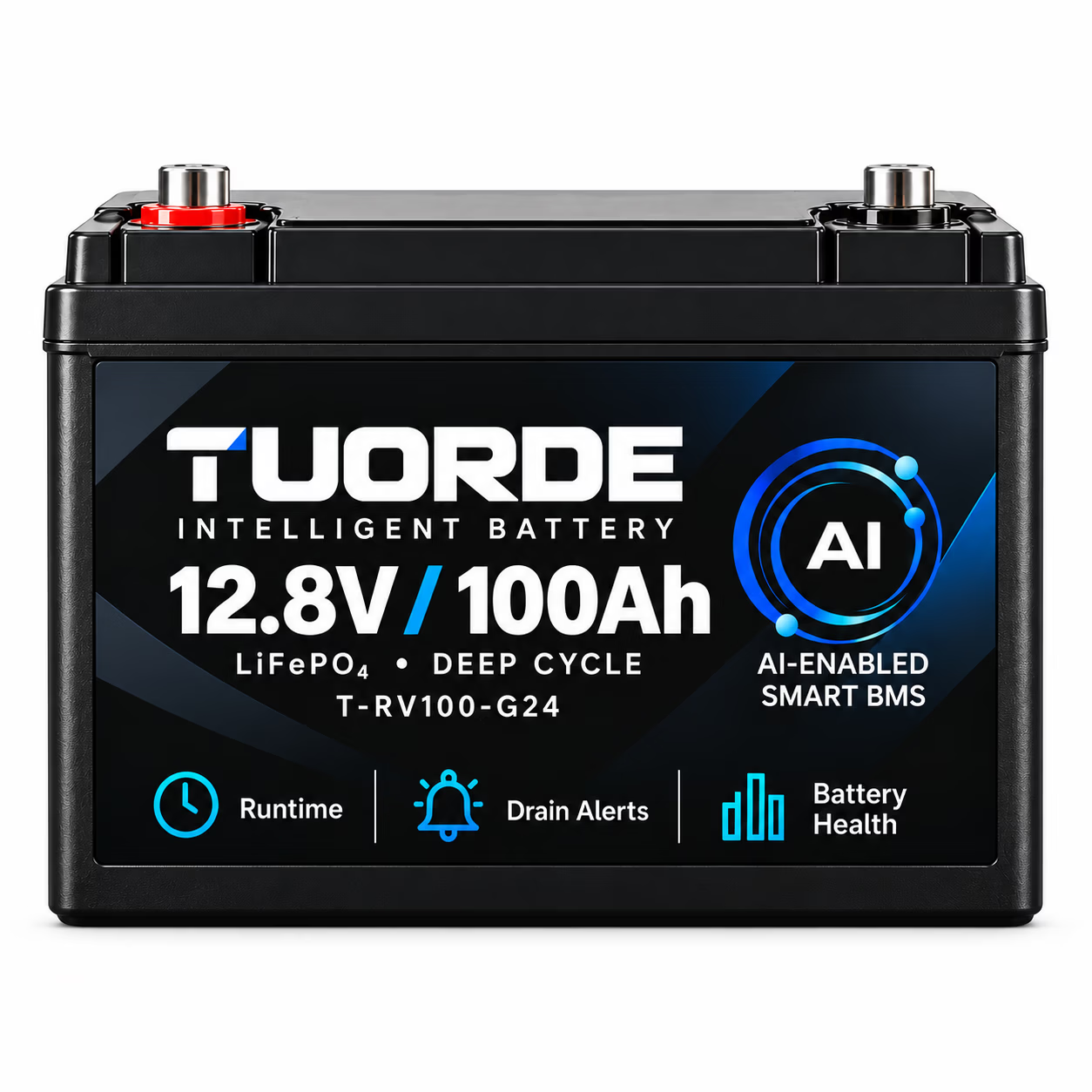
TUORDE 12.8V 100Ah Group 24 Smart LiFePO4 RV battery for compact camper van and travel trailer house power

COMPACT AI RV BATTERY

12V 100Ah Group 24 Smart LiFePO4 RV Battery

12.8V · 100Ah · 1.28kWh

For compact RV house-battery upgrades; review the linked Group 24 configuration’s drawing, terminal layout and BMS limits.

Smart BMS · App Options · OEM Customization

Request 100Ah Details → View 12V 100Ah RV Battery Specifications
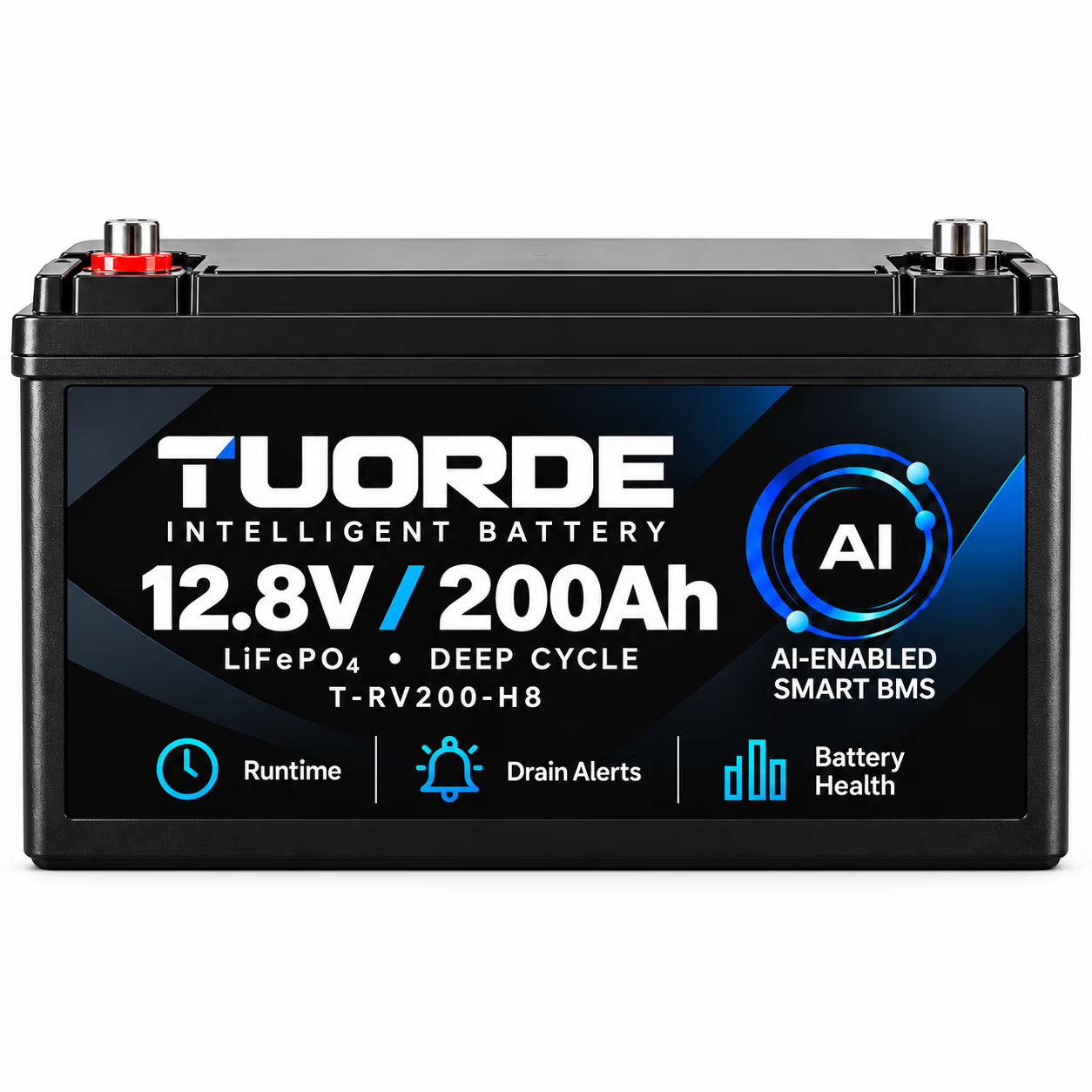
TUORDE 12.8V 200Ah H8 Smart LiFePO4 RV battery for motorhome and caravan house power applications

EXTENDED ENERGY PLATFORM

12V 200Ah H8 Smart LiFePO4 RV Battery

12.8V · 200Ah · 2.56kWh

For higher daily house-power demand; review the linked H8 platform’s target housing, charging requirements and current limits.

Smart BMS · AI Options · OEM Integration

Request 200Ah Details → Review 200Ah H8 Platform Specifications
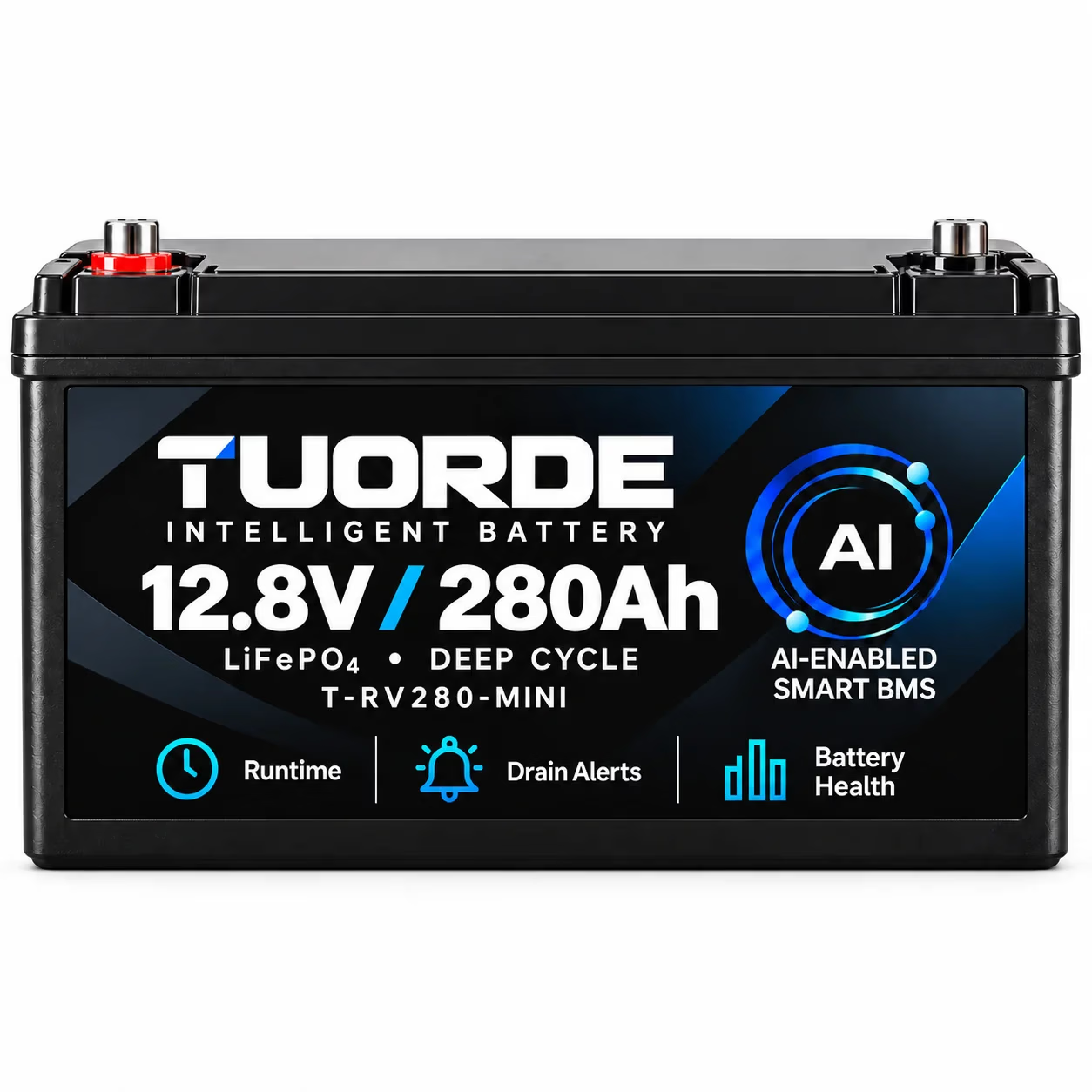
TUORDE 12.8V 280Ah MINI Smart LiFePO4 RV battery for Class C motorhome and fifth-wheel house power applications

HIGH-CAPACITY PLATFORM

12V 280Ah MINI Smart LiFePO4 RV Battery

12.8V · 280Ah · 3.584kWh

For Class C and fifth-wheel house-power projects; review the MINI platform’s target housing, BMS limits and charging requirements.

Smart BMS · AI Options · OEM Engineering

Request 280Ah MINI Details → View 280Ah MINI Specifications

Product images are illustrative. BMS ratings, dimensions, heating, interfaces and software features must be confirmed for each production configuration. Nominal energy is calculated from nominal voltage × rated capacity; usable energy and runtime depend on operating conditions.

The linked 100Ah Group 24, 200Ah H8 and 280Ah MINI listings are model-specific RV house batteries. Confirm the approved mechanical drawing, terminals and electrical ratings for the selected configuration. MINI is a platform identifier and does not establish Group 24 fit. Browse all AI Smart RV Batteries for other configurations.

AI BATTERY INTELLIGENCE

AI Battery Intelligence

TUORDE’s developed and tested AI capabilities support RV runtime estimates, abnormal drain alerts, battery health insights and guided troubleshooting. Available functions depend on the selected battery configuration.

01 / RUNTIME

AI Runtime Prediction

Estimate remaining operating time from available battery energy and measured consumption. Predictions depend on changing loads and validated models.

02 / POWER CONSUMPTION

Abnormal Drain Detection

Analyze energy consumption trends to identify unusual demand. Predictive alerts do not replace protective devices or electrical fault detection.

03 / BATTERY HEALTH

Battery Health Insights

Review battery operating history, estimated health and temperature-related trends, subject to measurement accuracy.

One-Tap Smart Troubleshooting: Run battery diagnostics, identify abnormal conditions and follow guided troubleshooting steps. Diagnostics do not perform physical battery repair.
Feature availability: AI functions depend on the selected BMS, firmware, app and system integration. Confirm the required OEM feature configuration before ordering.

Learn More About Smart BMS & AI RV Battery Technology

SMART BMS ENGINEERING

Designed for Real RV Electrical Systems

Accurate measurements, appropriate protection and validated communication interfaces are essential for reliable RV lithium systems.

BMS Protection Engineering

Cell overvoltage, undervoltage, current protection, temperature limits and balancing requirements.

CAN / RS485 Integration

Protocol mapping and communication validation for compatible RV power equipment.

Low-Temperature Protection

Charging restrictions and optional self-heating configurations for cold-climate applications.

Measurement & Validation

Capacity, voltage, current, temperature and protection testing under specified conditions.

Victron and other third-party compatibility requires device-specific validation.

BATTERY SIZING

Choose Battery Capacity Based on Real Energy Demand

Size the lithium battery system using actual daily power demand, required autonomy and charging availability.

STEP 01

Calculate Daily Energy Use

Record appliance power, operating hours, DC loads and inverter losses.

STEP 02

Determine Off-Grid Autonomy

Define the required operating period without sufficient charging sources.

STEP 03

Verify Power & Charging

Confirm BMS current, surge loads, charger output, cables and protective devices.

Example: 1,500Wh/day × 2 days = 3,000Wh of usable energy. At an assumed 90% usable energy fraction, approximately 3.33kWh of nominal battery storage is needed before additional operating reserves.

OEM / ODM BATTERY DEVELOPMENT

OEM / ODM Battery Development

Project-specific engineering, prototype evaluation and manufacturing support for RV manufacturers, retrofit specialists and distributors.

01 / REQUIREMENTS

System Review

Assess dimensions, voltage, charging equipment, inverter loads and target market.

02 / ENGINEERING

Battery Configuration

Define capacity, BMS, enclosure, terminals, communications and AI options.

03 / VALIDATION

Prototype Testing

Evaluate electrical, thermal, protection, fitment and communication performance.

04 / DELIVERY

OEM Production

Finalize specifications, quality criteria, private labeling and packaging.

TECHNICAL FAQ

RV Lead-Acid to Lithium Battery Replacement FAQ

Technical guidance for RV manufacturers, retrofit specialists and battery distributors.

1. Can I replace my RV lead acid battery with lithium?

Many RV systems can be upgraded from lead-acid batteries to LiFePO4 lithium batteries. Before installation, battery dimensions, voltage requirements, charging systems, inverter compatibility, wiring and protection requirements must be verified.

2. What size lithium battery do I need for my RV?

Battery capacity depends on daily energy consumption, inverter loads, charging sources and required off-grid operating time. TUORDE provides 12V 100Ah, 200Ah and higher-capacity LiFePO4 RV battery platforms for different energy requirements.

3. Are Group 24, Group 27 and Group 31 lithium batteries direct replacements?

Group size is only a physical reference. Always confirm battery dimensions, terminal position, installation space and electrical compatibility before replacing a lead-acid RV battery.

4. Can I keep my existing RV solar system after upgrading to lithium?

Most RV solar systems can continue to be used after upgrading to lithium. The solar charge controller must support LiFePO4 charging profiles, correct voltage settings and appropriate current limits.

5. Can I use my existing RV charger with a LiFePO4 battery?

The existing charger can only be used if charging voltage, current limits and charging modes are compatible with LiFePO4 batteries. Lead-acid equalization or desulfation modes should not be used.

6. Do I need a DC-DC charger for RV alternator charging?

A DC-DC charger is commonly used for lithium RV upgrades to regulate charging current and protect the alternator and battery system. The correct configuration depends on the vehicle electrical design.

7. Do I need to change my RV inverter after installing lithium batteries?

Not always. The inverter power rating, startup surge, charging function and compatibility with LiFePO4 battery voltage and BMS limits should be checked before installation.

8. What BMS current rating do I need for my RV battery system?

The required BMS current depends on inverter power, continuous loads, peak loads and battery configuration. TUORDE supports different BMS current options for various RV power requirements.

9. What is the difference between Smart BMS, App monitoring and AI battery intelligence?

The BMS provides battery protection and measurement data, while the app displays battery information. Selected configurations use AI analysis for runtime estimates, abnormal drain alerts, battery health insights and guided troubleshooting. Guided diagnostics do not perform physical battery repair.

10. Can TUORDE batteries communicate with Victron or other RV systems?

Selected TUORDE battery configurations support communication options such as CAN and RS485. Compatibility depends on the specific battery model, communication protocol and connected RV equipment.

11. Can LiFePO4 RV batteries charge below 0°C?

Charging temperature limits must follow battery specifications. TUORDE supports optional low-temperature charging protection and self-heating configurations for cold-climate RV applications.

12. Can TUORDE support OEM and private-label RV battery programs?

Yes. TUORDE supports OEM and private-label RV battery projects including battery configuration, BMS customization, communication interfaces, packaging design and production support.


OEM & PRIVATE LABEL SOLUTIONS

Ready to Build Your Next RV Lithium Battery Solution?

Partner with TUORDE for intelligent RV lithium battery upgrades, custom BMS configurations and private-label manufacturing.

Share your project requirements to explore the right battery platform, intelligent features and OEM solution for your brand.

Confirm model-specific AI features, integration requirements and sample availability.

Information for a Faster Technical Review

Tell us about your RV battery project so our engineering team can evaluate a suitable configuration.

  • Company, country and business role
  • Target battery: 100Ah / 200Ah / 280Ah MINI / Custom
  • Original battery specifications
  • Battery compartment dimensions
  • Inverter continuous and surge power
  • Shore charger, MPPT and DC-DC models
  • Operating temperature and self-heating needs
  • App, CAN/RS485 and AI feature requirements
  • Prototype quantity and estimated annual volume