SMART RV ENERGY TECHNOLOGY
TUORDE combines advanced BMS architecture, communication technology and AI-powered analytics to create smarter LiFePO4 battery systems for modern RV applications.
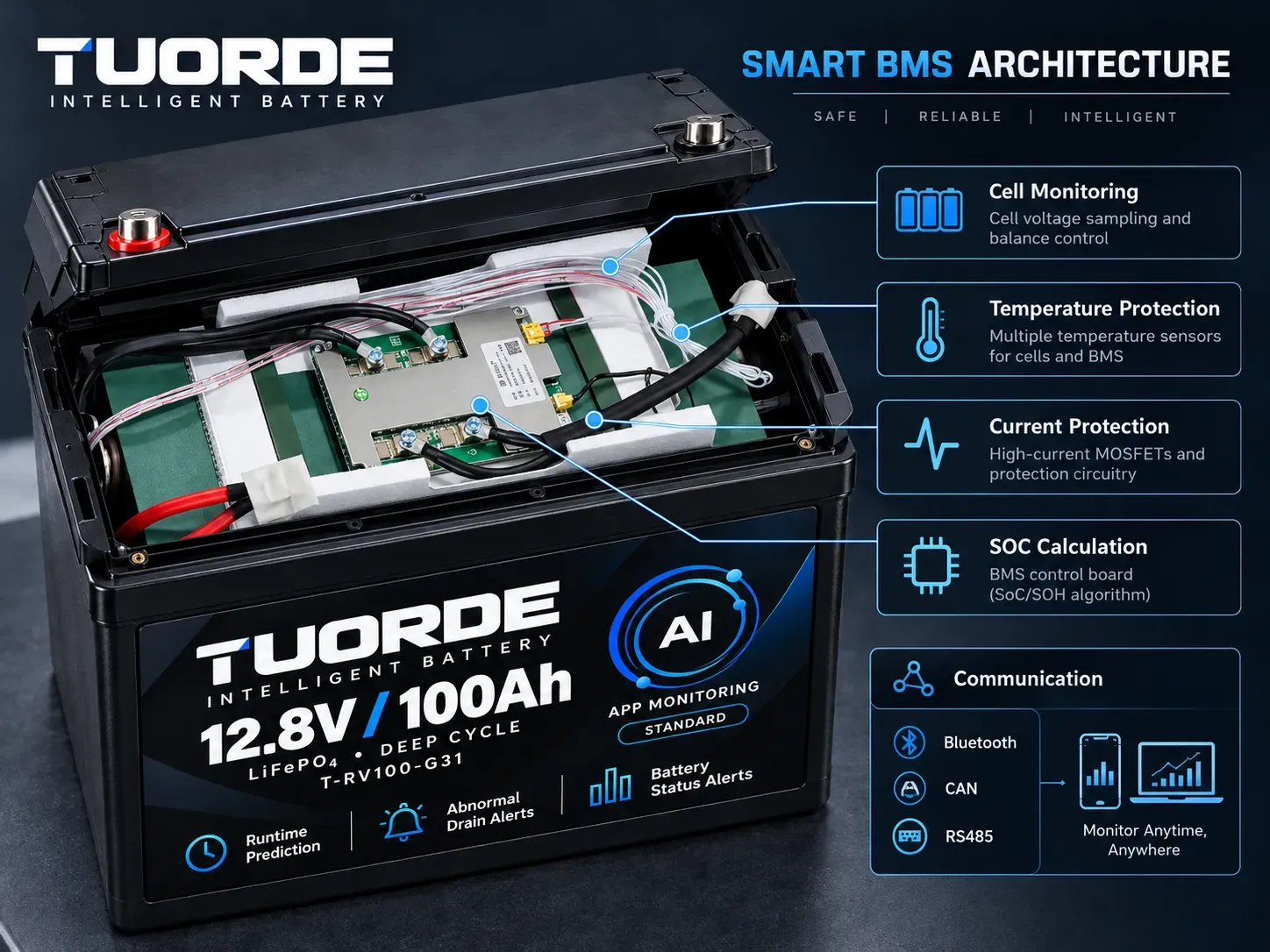
MEASURE
Cell and pack conditions
CONNECT
Battery data and RV systems
INTERPRET
Runtime, usage and health
01 / THE FOUNDATION
A connected battery begins with reliable measurements. The BMS turns cell-level signals into protection decisions and usable system data.
Real-time monitoring of cell voltage, temperature and balance status helps reveal conditions that pack voltage alone cannot show.
Configured limits address overvoltage, undervoltage, overcurrent and temperature conditions. Protection responses must match the battery and application.
Bluetooth, CAN and RS485 options make battery information available to users and connected RV equipment.
Measurement history becomes useful insight when interpreted in the context of battery condition and changing energy demand.
02 / THE DATA PATH
Follow the information from LiFePO4 cells to an actionable view of the RV energy system. This is a conceptual data flow; sensors feed the BMS, while protection operates locally.
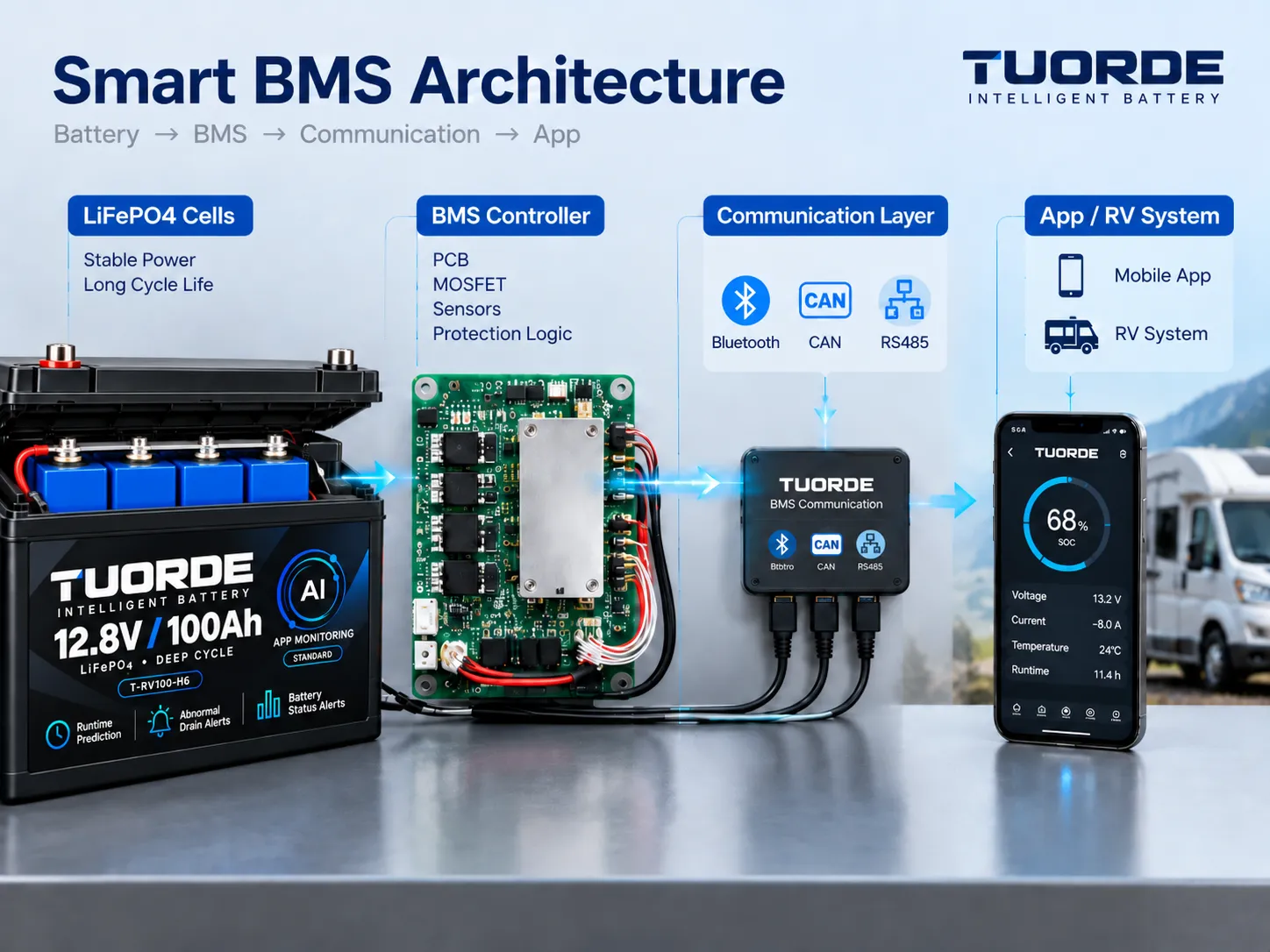
STEP 1
Cell voltage and pack condition provide the foundation for battery monitoring.
STEP 2
Processes cell data, calculates SOC and applies configured protection logic.
STEP 3
Temperature sensing and current measurement inform charging, discharge and fault responses.
STEP 4
Supported Bluetooth, CAN or RS485 interfaces transmit battery status and measurements.
STEP 5
Displays information for the user or exchanges data with compatible connected equipment.
The BMS enforces configured operating limits. App displays and AI insights support decisions; they do not replace electrical protection, correct installation or equipment validation.
03 / FROM DATA TO INSIGHT
Understand how long energy may last, recognize unexpected consumption and track battery condition. The figures below are illustrative examples, not guaranteed operating results.
Estimate available operating time based on battery condition and energy consumption. Predictions update as loads change.
STATE OF CHARGE
68%
ESTIMATED RUNTIME
11.4h
ILLUSTRATIVE DATA
Identify unusual power behavior before it affects RV operation. An alert indicates a condition to investigate; it does not identify the cause by itself.
EXAMPLE BASELINE LOAD
320W
Unexpected energy consumption detected
ILLUSTRATIVE DATA
Understand battery condition and long-term performance using measurements and operating history. Health estimates depend on data quality and the selected model.
ESTIMATED STATE OF HEALTH
92%
Cell Balance: Good
Temperature: Normal
ILLUSTRATIVE DATA
Run battery diagnostics, identify abnormal conditions and follow guided troubleshooting steps. Availability depends on the selected battery configuration. Diagnostics do not perform physical battery repair.
GUIDED DIAGNOSTIC WORKFLOW
Feature availability depends on BMS hardware, sensors, firmware, app functions and validation of the selected battery configuration.
04 / THE USER EXPERIENCE
An RV battery monitoring system should make the important information easy to find: available energy, current operating conditions and issues that need attention.
LiFePO4 battery monitoring with a compatible Bluetooth app brings battery status into a clear user interface. Connection methods and available fields depend on the selected configuration.
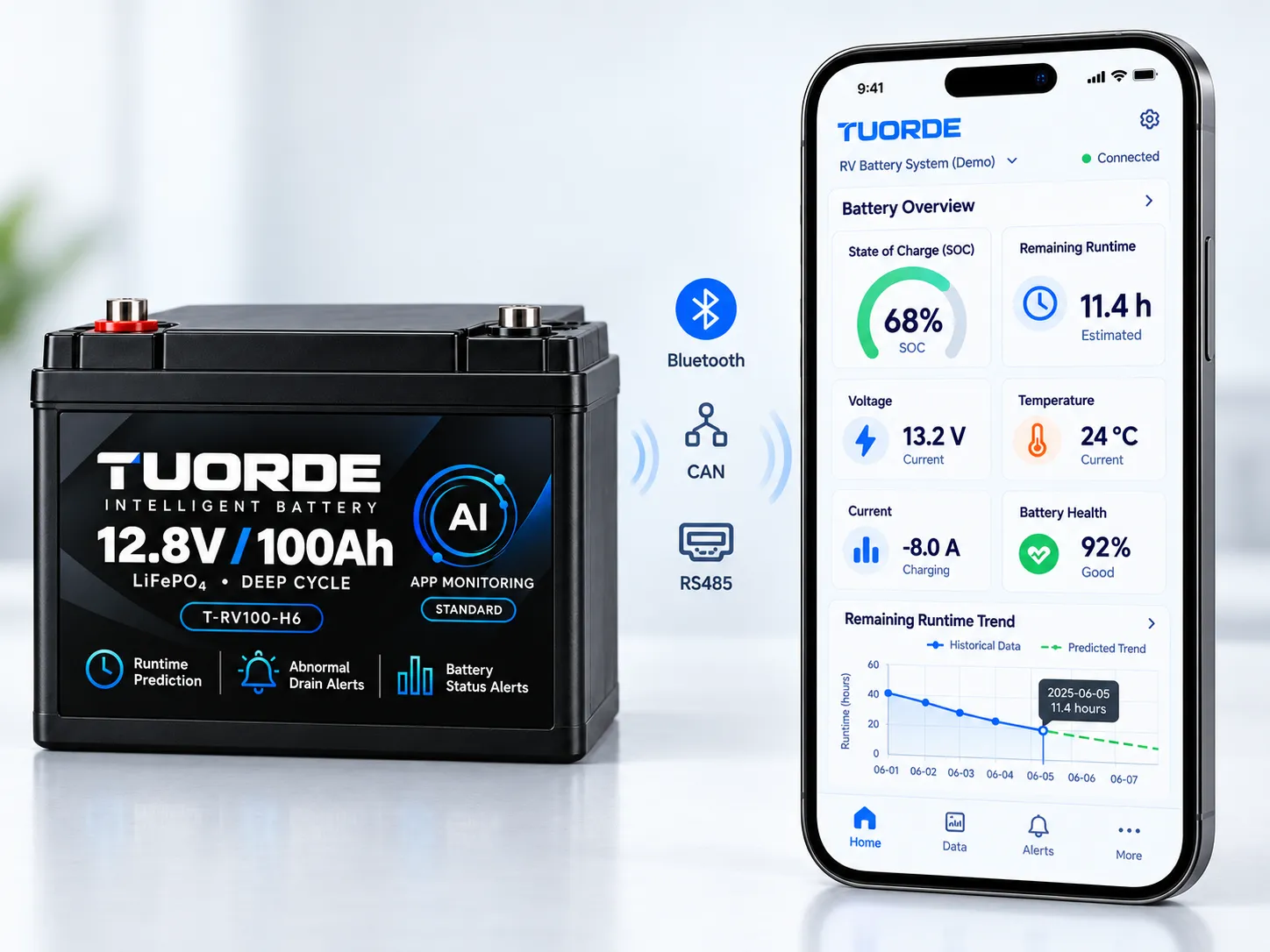
BATTERY OVERVIEW / INTERFACE EXAMPLE
Illustrative values. Runtime changes with load and operating conditions.
05 / CONNECTED SYSTEMS
Mobile access for RV users through a compatible app. Confirm pairing, supported data fields and connection behavior.
Integration with advanced RV energy systems using matched message formats, protocol profiles and firmware.
Reliable industrial communication options for compatible connected equipment and specified system architectures.
Review chargers, inverters and energy management systems against the battery limits and supported communication profile.
A CAN or RS485 port alone does not establish compatibility. Verify equipment model, wiring, firmware and communication protocol before integration.
RV Battery Compatibility Guide06 / ENGINEERING VALIDATION
A smart battery program needs validation across the agreed operating range. Review the test scope and results for the exact production configuration.
| Test Area | Engineering Focus |
|---|---|
| Charge and discharge testing | Current capability, charging behavior and load response within specified limits. |
| Temperature validation | Sensor readings, protection behavior and optional heating across the specified operating range. |
| Protection testing | Configured voltage, current and temperature thresholds and recovery logic. |
| Communication testing | Data accuracy, message mapping, connection behavior and protocol validation with target equipment. |
This overview describes validation areas. Request model-specific specifications and available test documentation for your project.
07 / YOUR INTELLIGENT BATTERY PROGRAM
TUORDE helps RV brands and battery partners develop intelligent lithium solutions with customized BMS configuration, communication protocols, app functions and battery intelligence features.
Choose a starting platform from AI Smart RV Batteries: 100Ah Group 24 for compact house-battery projects, 200Ah H8 for model-specific height and capacity review, or 280Ah MINI for larger daily energy budgets. Bluetooth, CAN, RS485 and predictive insights require the selected hardware, firmware and app configuration; the CORE designation alone does not confirm these functions.
Target loads, operating conditions, monitoring needs and connected equipment.
BMS limits, supported interfaces, app functions and private-label requirements.
Prototype behavior, data exchange and agreed acceptance criteria before production.
08 / TECHNICAL QUESTIONS
A Smart BMS monitors cell voltage, temperature, current and battery status while controlling battery protection functions. Compared with a traditional BMS, Smart BMS can also communicate battery information through Bluetooth, CAN or RS485 interfaces for connected RV energy systems.
Traditional BMS technology focuses on measurement and protection. AI battery intelligence uses operating data to provide additional insights such as runtime estimation, energy usage patterns and battery health trends.
Selected TUORDE intelligent battery configurations can estimate remaining runtime based on battery status, energy consumption and operating conditions. Actual runtime varies depending on connected loads and system usage.
Smart battery analytics can identify unusual energy consumption patterns by comparing current operation with expected usage behavior. Alerts help users investigate possible issues but do not replace proper system inspection.
Selected TUORDE RV lithium battery configurations support Bluetooth monitoring through compatible applications, allowing users to view information including SOC, voltage, current and temperature.
Yes. Selected TUORDE battery configurations support CAN and RS485 communication for integration with compatible RV systems. Communication protocols and equipment compatibility must be validated for each application.
Smart BMS improves battery safety by continuously monitoring important operating conditions and managing protection responses related to voltage, current and temperature limits.
Yes. TUORDE supports OEM customers with customized BMS parameters, communication protocols, app functions, battery configurations and intelligent monitoring features.
Explore TUORDE intelligent RV lithium battery solutions or work with our engineering team on customized Smart BMS and OEM battery programs.