

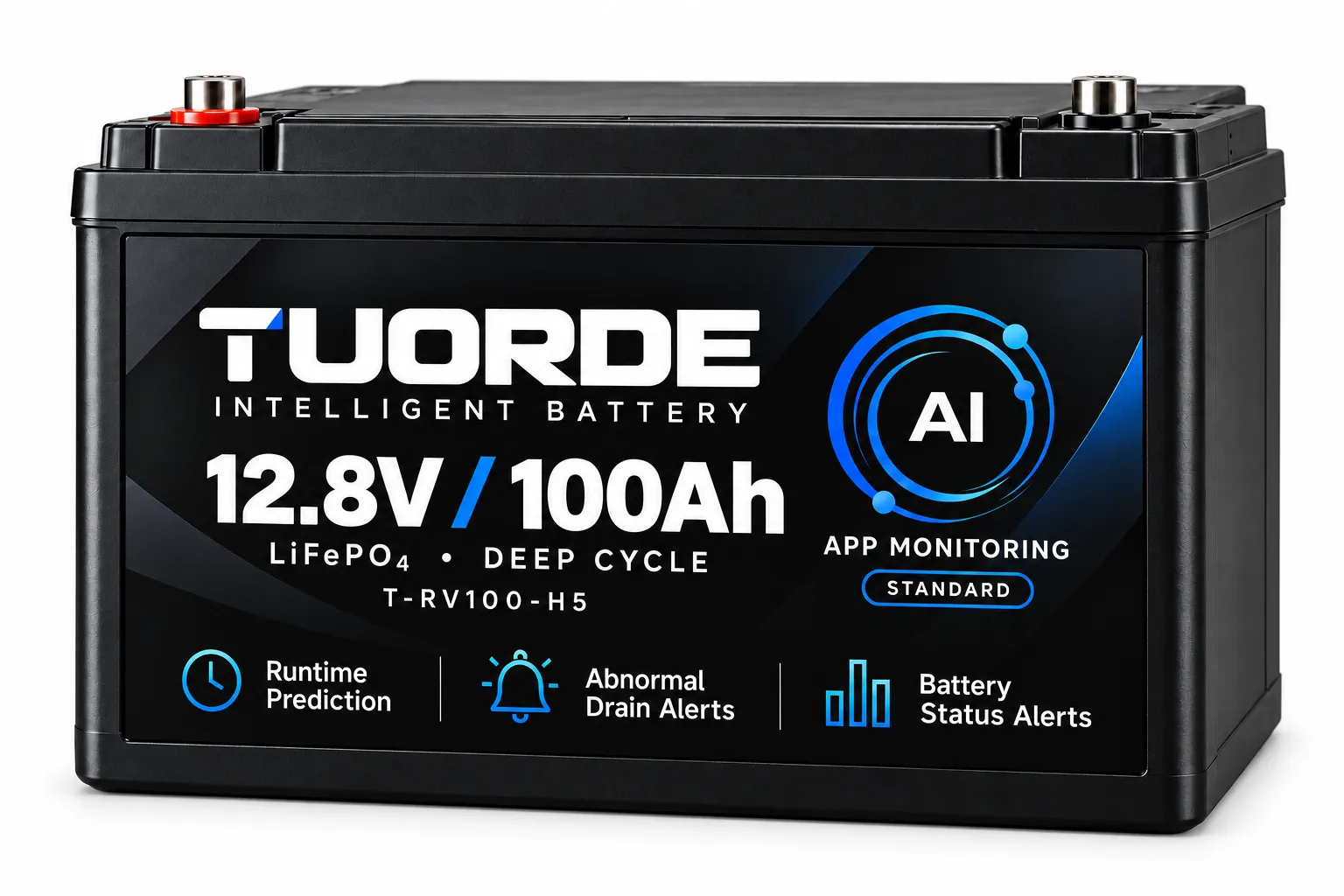
100Ah GROUP 24 PLATFORM
12V 100Ah Group 24 Smart LiFePO4 RV Battery
1.28kWh Nominal Energy
Travel trailers · Camper vans
P100 CORE · Monitoring options
RV LITHIUM BATTERY SOLUTIONS
Compare 12V LiFePO4 house-battery platforms for camper vans, travel trailers and motorhomes. Start with installation space and daily energy demand, then match BMS current, charging equipment and monitoring options to your RV system or OEM battery program.
RV application · Energy demand · Intelligent features · OEM configuration
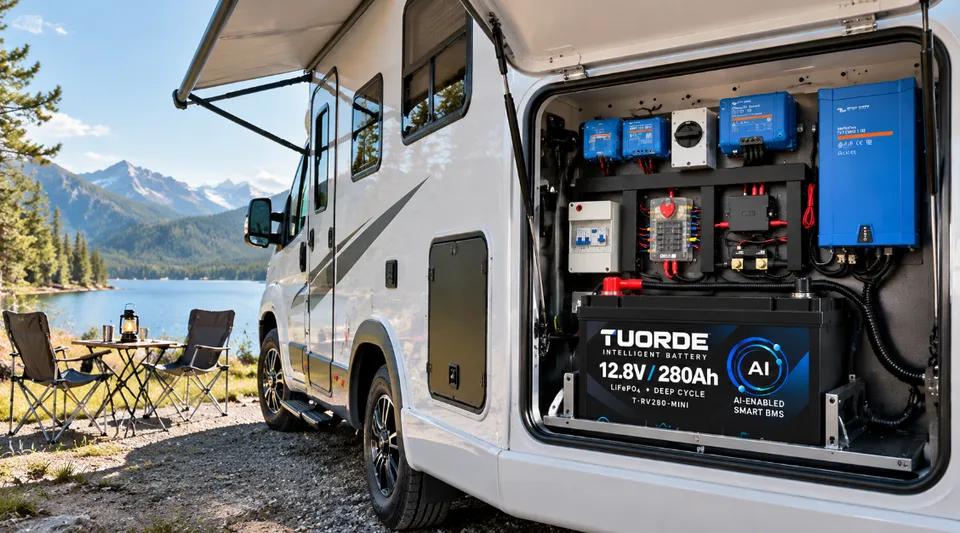
Compare capacity, enclosure dimensions and terminals against your RV layout and energy budget.
Specify BMS protection, Bluetooth app access and CAN / RS485 options for the selected configuration.
Solutions for camper vans, travel trailers, motorhomes and off-grid RV systems.
Custom battery configurations, BMS options and private-label manufacturing support.
For RV manufacturers, installers, distributors and private-label brands, the first decision is how much house energy the installation needs between charging opportunities. Separate everyday DC loads from short, high-power inverter loads.
These are illustrative planning assumptions, not measured TUORDE runtime results. Replace each value with your own appliance consumption and duty cycle.
| Illustrative load | Assumed average power | Daily use | Battery-side energy |
|---|---|---|---|
| DC refrigerator | 35 W average including cycling | 24 h | 840 Wh |
| DC lighting | 12 W | 5 h | 60 Wh |
| DC ventilation fan | 15 W | 6 h | 90 Wh |
| DC water pump | 60 W | 0.25 h | 15 Wh |
| DC electronics | 30 W | 4 h | 120 Wh |
| Small AC load through inverter | 300 W AC; assumed 90% efficiency | 0.5 h | 167 Wh |
Estimated daily consumption: about 1,292 Wh. An illustrative 20% planning margin brings the energy requirement to about 1.55 kWh. Confirm inverter standby use and other losses separately, and avoid counting the same loss twice.
A 100Ah / 12.8V platform stores 1.28 kWh nominally, so it would not meet this example on nominal energy alone. The 200Ah / 2.56 kWh platform is a starting point to assess for this one-day budget, subject to its permitted usable window, current limits, temperature and fit.
Two similar days without reliable recharge would require about 3.10 kWh with the same illustrative margin. The 280Ah / 3.584 kWh platform becomes a higher-energy candidate to review, while usable energy, enclosure fit and charging capacity still need confirmation.
The 20% margin is a planning assumption, not a specified battery depth of discharge or a guaranteed reserve. Compare the required energy with the energy available within the approved model operating limits. Check simultaneous and startup power separately from daily Wh.
Before increasing capacity, compare the energy used between charging opportunities with the energy your shore charger, driving time and realistic solar yield can replace. If daily replenishment remains below daily use, a larger battery only extends the interval before a shortfall.
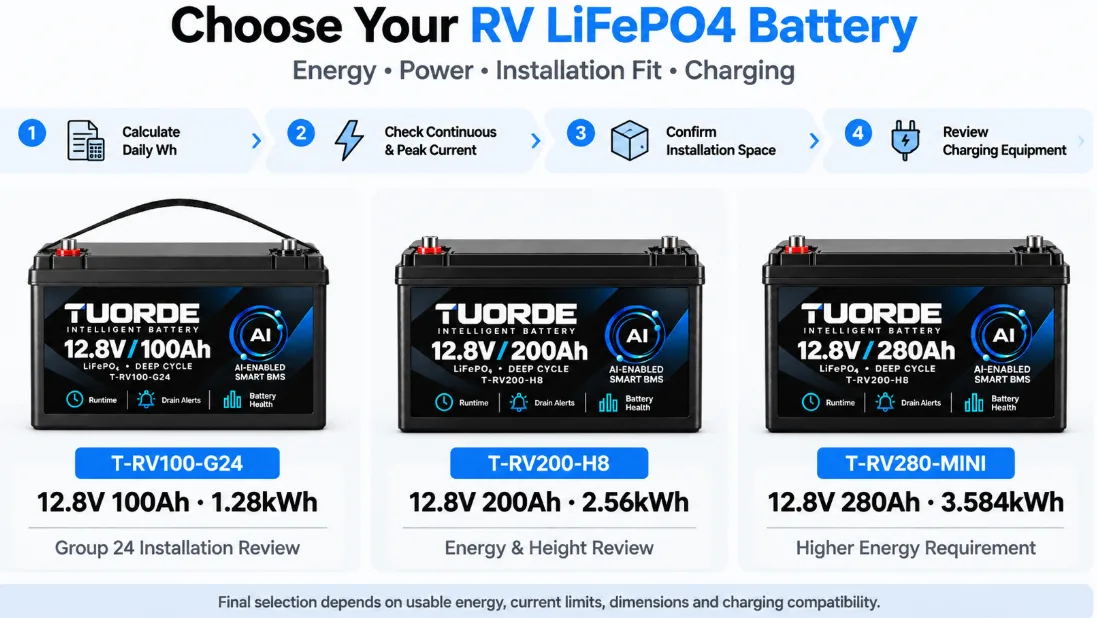
Compare three distinct platforms: a 100Ah Group 24 LiFePO4 battery, a 200Ah H8 platform with a 190mm approved enclosure height, and a 280Ah MINI house-energy platform. Capacity does not establish physical fit, inverter capability or runtime; use each linked model’s data for selection.
100Ah GROUP 24 PLATFORM
1.28kWh Nominal Energy
Travel trailers · Camper vans
P100 CORE · Monitoring options
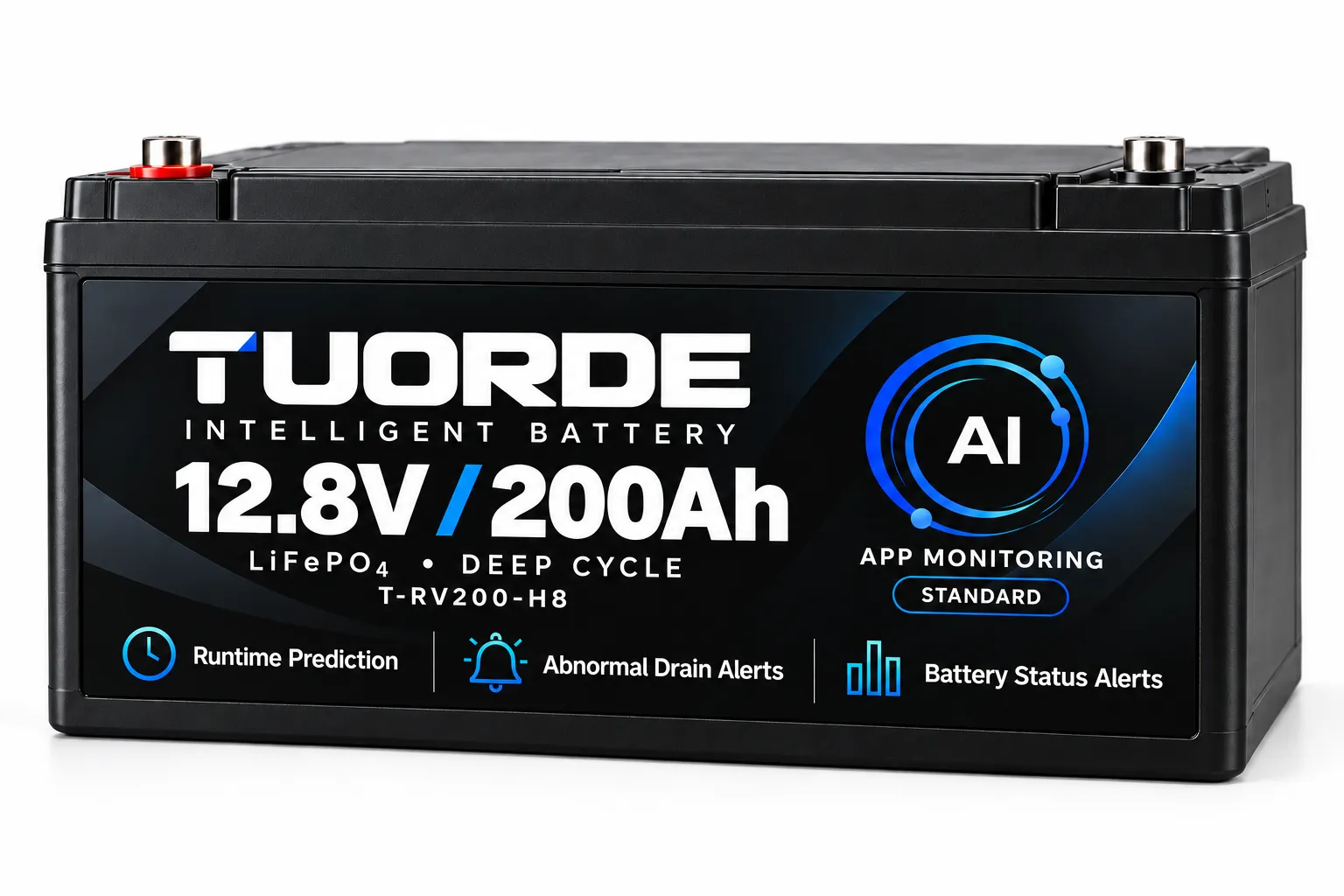
H8 INSTALLATION HEIGHT
2.56kWh Nominal Energy
European motorhomes · Caravans
P200 CORE · Configuration review
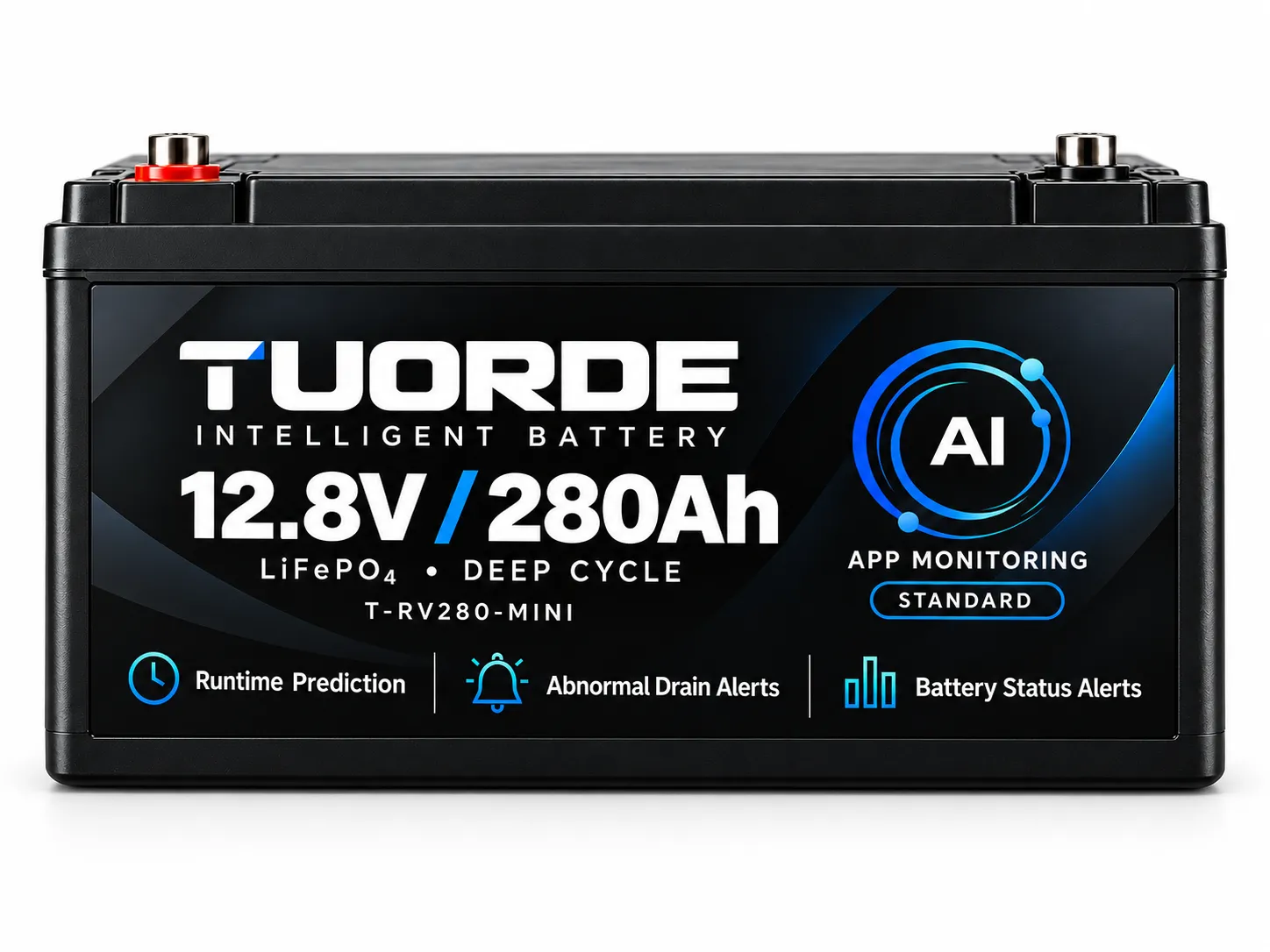
280Ah HOUSE-ENERGY PLATFORM
3.584kWh Nominal Energy
Class C motorhomes · Fifth wheels
P250 CORE · Interface options
Images illustrate capacity platforms; the linked model drawings govern actual enclosure and fit. Select the appropriate battery by matching enclosure dimensions, BMS current ratings, charging requirements, heating, system interfaces and software configuration to your RV installation.
| Model / nominal energy | When to consider it | When to review another configuration | Model inquiry |
|---|---|---|---|
| T-RV100-G24 · 1.28 kWh | The calculated energy requirement fits within the approved usable window and the Group 24 enclosure suits the installation. | Daily energy or inverter current exceeds the model limits, charging below the permitted temperature is expected, or the compartment / terminal clearance differs. | Discuss T-RV100-G24 on WhatsApp |
| T-RV200-H8 · 2.56 kWh | A higher house-energy budget and an installation where height is a priority. | The complete enclosure or terminal-inclusive height does not fit, required current exceeds approved limits, or the energy interval exceeds the usable budget. The approved model height is 190mm; check the full drawing, terminal clearance and mounting for your vehicle. | Discuss T-RV200-H8 on WhatsApp |
| T-RV280-MINI · 3.584 kWh | A larger energy budget or a longer interval between reliable charging opportunities, with suitable mounting and clearance. | Space, weight, current or charging constraints remain unresolved. More Ah alone does not establish inverter suitability or an approved series / parallel arrangement. | Discuss T-RV280-MINI on WhatsApp |
The product links above provide model-specific information. Confirm available configurations, drawings, usable energy, charging limits and current ratings together. A larger Ah rating does not establish engine-starting capability or interchangeable fit.
Prioritize enclosure fit, mounting and cable clearance, then calculate daily auxiliary-load demand.
Match lighting, pumps and other house loads to stored energy and the time between charging opportunities.
Review available installation height, inverter loads and integration with the existing house-power system.
Balance energy reserve, solar yield, charging opportunities and temperature conditions for the intended journey.
For an existing lead-acid house battery system, RV Lead Acid To Lithium Battery Replacement provides a dedicated installation and charging guide.
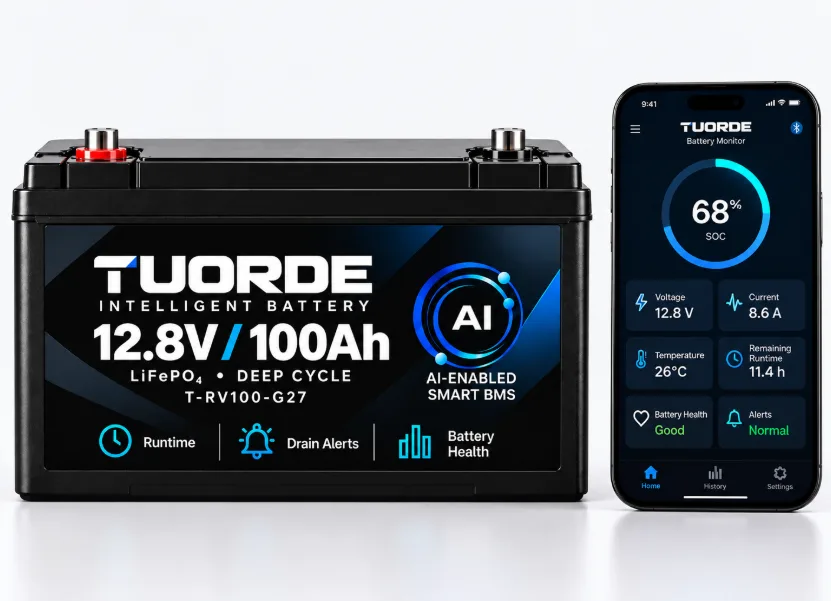
Battery monitoring, protection management and safety functions.
Monitor SOC, voltage, current, temperature and battery status.
Runtime Prediction estimates remaining operating time. Abnormal Drain Detection identifies unexpected power consumption. Battery Health Intelligence tracks battery-health trends. One-Tap Smart Troubleshooting guides users through diagnosis and resolution.
Available functions depend on the selected BMS, sensors, firmware and app configuration. Predictive insights help users plan energy use and complement battery protection.
Lithium charging configuration and MPPT compatibility.
Power requirements and startup load considerations.
Alternator charging support and current management.
Battery communication and system integration options.
| Equipment | May remain when… | Adjust, replace or add equipment when… |
|---|---|---|
| Shore converter / inverter-charger | The documented charge profile, voltage and current settings meet the selected battery specification. | Settings need revision, or an unsuitable fixed profile / equalization mode cannot be disabled. Confirm the exact equipment model and its operating modes. |
| Solar controller | PV input limits and battery-side voltage / current settings suit the array and selected battery. | The required profile, current limits or low-temperature charging strategy cannot be supported. Use realistic daily yield for energy planning. |
| Alternator / charging interface | The vehicle architecture, alternator limits, isolation and current control suit the approved configuration. | Current limiting, voltage conversion or isolation is needed. Review a suitable DC-DC charging interface for the vehicle rather than assuming direct connection. |
| Inverter, wiring & protection | Continuous / startup demand, voltage cutoffs, conductor ratings and external protection meet the revised design. | Current demand exceeds the pack limits, startup trips occur, or cables / fuses / disconnects need changing. A larger Ah rating alone may not resolve a current mismatch. |
Mechanical fit: confirm the drawing revision, terminal-inclusive height, hold-downs, cable bends, terminal covers and service access. Obtain model-specific instructions for series / parallel arrangements.
Climate & communication: distinguish low-temperature charge protection from self-heating. Confirm heating behavior, Bluetooth functions, CAN / RS485 pinout, protocol and firmware for the selected configuration.
Use the detailed compatibility and replacement guides below for installation planning. The comparison above supports configuration review; the approved equipment and battery instructions govern installation.
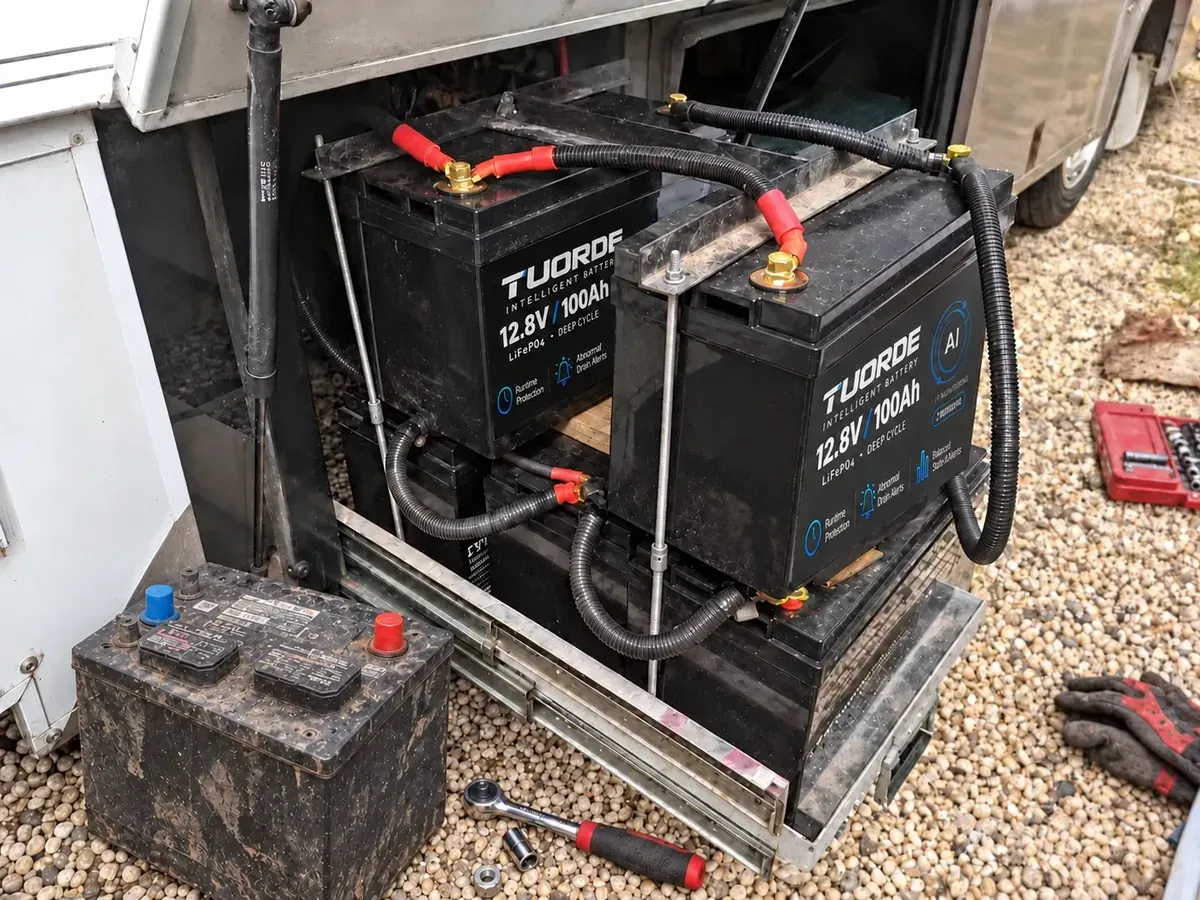
Compatibility depends on equipment model, firmware, charging settings and communication protocol. CAN or RS485 connectors alone do not establish compatibility. Explore enclosure options in our Group 24 Lithium Battery, Group 27 Lithium Battery and Group 31 Lithium Battery guides. Compare Group 24, Group 27 and Group 31 Lithium Battery Sizes.
RV Lithium Battery Compatibility GuideFor RV manufacturers, upfitters, distributors and battery brands, define the mechanical and electrical requirements before selecting the private-label configuration.
Configure capacity, housing, BMS current, communication interfaces, app options and packaging around your product program. Share your target market and annual volume to plan engineering review and prototype validation.
Start Your OEM ProjectUse the linked product pages for current model data and the Resources & Guides for supporting selection information. Request the datasheet, mechanical drawing, charging instructions and communication documentation for the exact model and configuration, including document revisions.
For application evidence, request available pack-level charge / discharge and load records relevant to your temperature range and installation. Identify the battery / BMS revision, load, test duration, operating limits and connected equipment. Review any certification or transport document against the exact model and destination; application illustrations do not establish tested runtime or vehicle compatibility.
Each document request opens WhatsApp with the RV application and selected model included. Specify the required configuration, installation conditions and document revisions.
The best LiFePO4 RV battery fits your installation space and matches your system voltage, energy demand and inverter current. Choose monitoring and communication features that suit your RV equipment.
Add up daily energy consumption in watt-hours, then allow for the time between charging opportunities and a practical reserve. Compare nominal energy, usable capacity and BMS current limits before selecting a 100Ah, 200Ah or higher-capacity platform.
At 12.8V nominal voltage, a 100Ah battery stores 1.28kWh and a 200Ah battery stores 2.56kWh. The larger platform provides more stored energy; dimensions, weight and discharge current depend on the selected model.
Yes. A camper van lithium battery can provide compact energy storage for auxiliary loads and off-grid use. Check installation space, daily energy demand, mounting and charging requirements when choosing a platform.
Yes, with a solar charge controller configured for the battery’s LiFePO4 charging profile, voltage and current limits. Size the solar array around your daily energy demand and charging conditions.
Selected TUORDE configurations support Smart BMS measurements and protection, with app monitoring and CAN or RS485 options. Confirm supported data, firmware and communication protocols for your connected RV system.
Yes. TUORDE supports capacity, housing, BMS current, heating, monitoring and communication configuration options. Share your installation space and electrical requirements so engineers can define a suitable battery specification.
Yes. TUORDE supports RV manufacturers, brands and distributors with private labels, packaging, BMS options and engineering support from specification review to prototype validation and production planning.
Send your RV type, preferred model (or ask for a recommendation), compartment drawing or dimensions, daily Wh budget, simultaneous and surge loads, charging-equipment models and operating climate. For OEM inquiries, add your company, country / region, quantity, target market and branding or interface requirements.
Get Your RV Battery RecommendationFor individual RV upgrades, distributor programs and OEM projects.