GROUP 24 SMART LITHIUM BATTERY
Compact 12.8V LiFePO4 Power with Smart BMS Technology
Plan compact RV house power around the battery bay, terminal clearance and cable access. Review TUORDE’s 100Ah Group 24 reference configuration against your daily loads, charging equipment and required Smart BMS options, with OEM customization for your battery program.
For RV manufacturers, battery distributors and private-label brands.
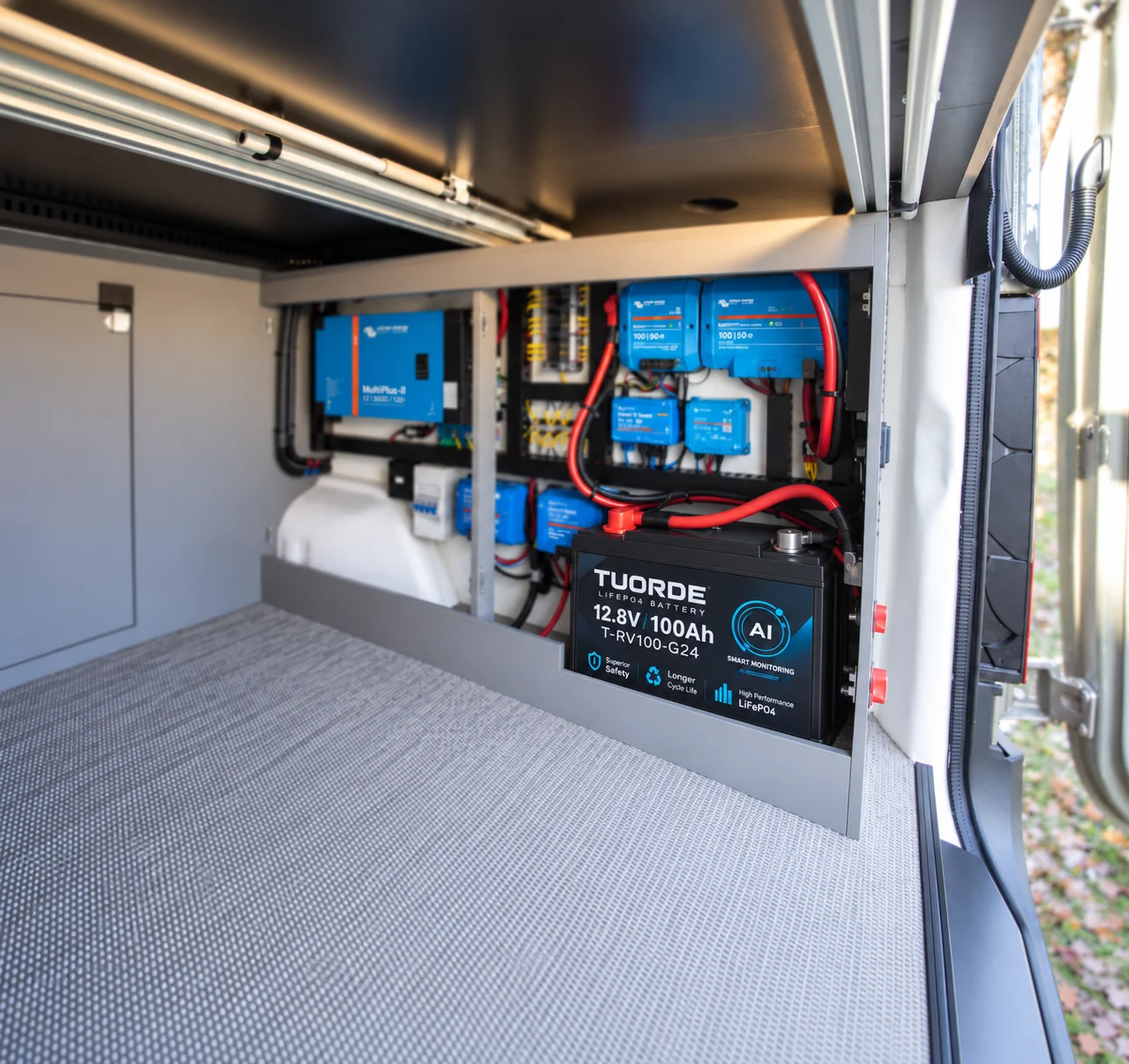
Group 24 is a physical platform, not a fixed capacity or current rating. Confirm the approved datasheet for your selected battery configuration.
| Parameter | Platform / Model Confirmation |
|---|---|
| Nominal voltage | 12.8V |
| Battery chemistry | LiFePO4 |
| Rated capacity / nominal energy | Confirm the approved datasheet for the selected model. |
| Dimensions / weight | Request the approved mechanical drawing and finished-pack weight. |
| Continuous discharge / maximum charging current | Confirm validated BMS and charging current ratings. |
| Monitoring / communication | Bluetooth, CAN, RS485, runtime prediction and battery health functions are configuration-specific options. |
| Self-heating | Confirm availability for the selected configuration. |
| Certifications | Request model-specific documentation; certification is not assumed. |
The linked T-RV100-G24 is an RV house battery. Dimensions, capacity and electrical limits require model-specific approval before installation. Nominal energy is calculated from nominal voltage × approved capacity; usable energy varies with operating conditions.
01
Check the usable tray footprint and complete installed height, including terminals, cable bends and retaining hardware.
02
Compare verified finished-pack weights before changing tray loading or mounting hardware.
03
Cell monitoring, temperature protection and communication options.
04
Stable energy storage for daily RV and camper applications.
Select a small RV lithium battery around usable energy and load requirements. Compare other capacities in RV Lithium Battery Solutions. Browse AI Smart RV Batteries for other housings and capacities; verify fit for the selected model.
| Feature | Lead Acid Group 24 | LiFePO4 Group 24 |
|---|---|---|
| Voltage | 12V nominal | 12.8V nominal |
| Usable Capacity | Usable energy varies with discharge depth and load. | Higher usable energy at a comparable rated capacity, within model limits. |
| Weight | Generally heavier at a comparable rated capacity. | Generally lighter; compare the selected model weights. |
| Cycle Life | Depends on battery type, discharge depth, temperature and maintenance. | Model-specific cycle rating; compare at equivalent test conditions. |
| Maintenance | Flooded batteries need watering; AGM batteries do not. | No electrolyte watering; inspect mounting, connections and charging settings. |
Compare model datasheets rather than chemistry alone. Runtime, weight and cycle life depend on the battery configuration and operating conditions.
Compact does not automatically mean compatible. Before a Group 24 RV battery replacement, measure the complete installation space and compare it with the selected battery drawing.
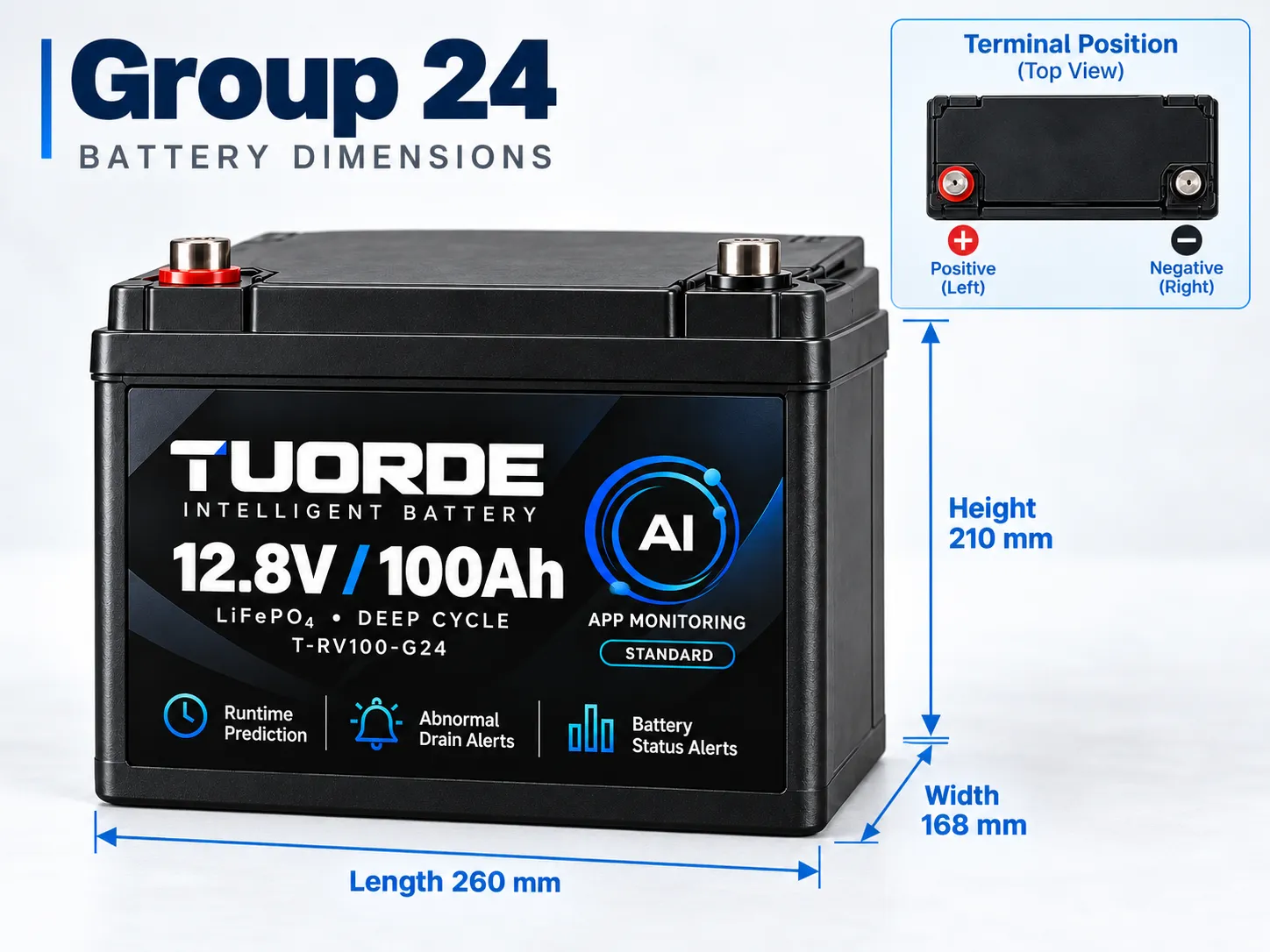
FIT CHECK 01
Measure the usable tray length, including housing projections.
FIT CHECK 02
Allow space for the battery body, straps and retaining hardware.
FIT CHECK 03
Include terminal covers, cable bends and clearance below the lid.
FIT CHECK 04
Confirm polarity, cable reach and connector requirements.
FIT CHECK 05
Keep access for mounting, inspection and the model’s installation requirements.
Review the RV Lithium Battery Compatibility Guide for charger, inverter and installation checks. Capacity does not define physical size. Compare Group 24, Group 27 and Group 31 Lithium Battery Sizes, or explore the Group 27 Lithium Battery and Group 31 Lithium Battery platforms.
Battery protection is the core BMS function. Protection thresholds and current limits must match the approved model specification. Connected monitoring and communication features are optional and depend on the selected BMS, firmware and app.
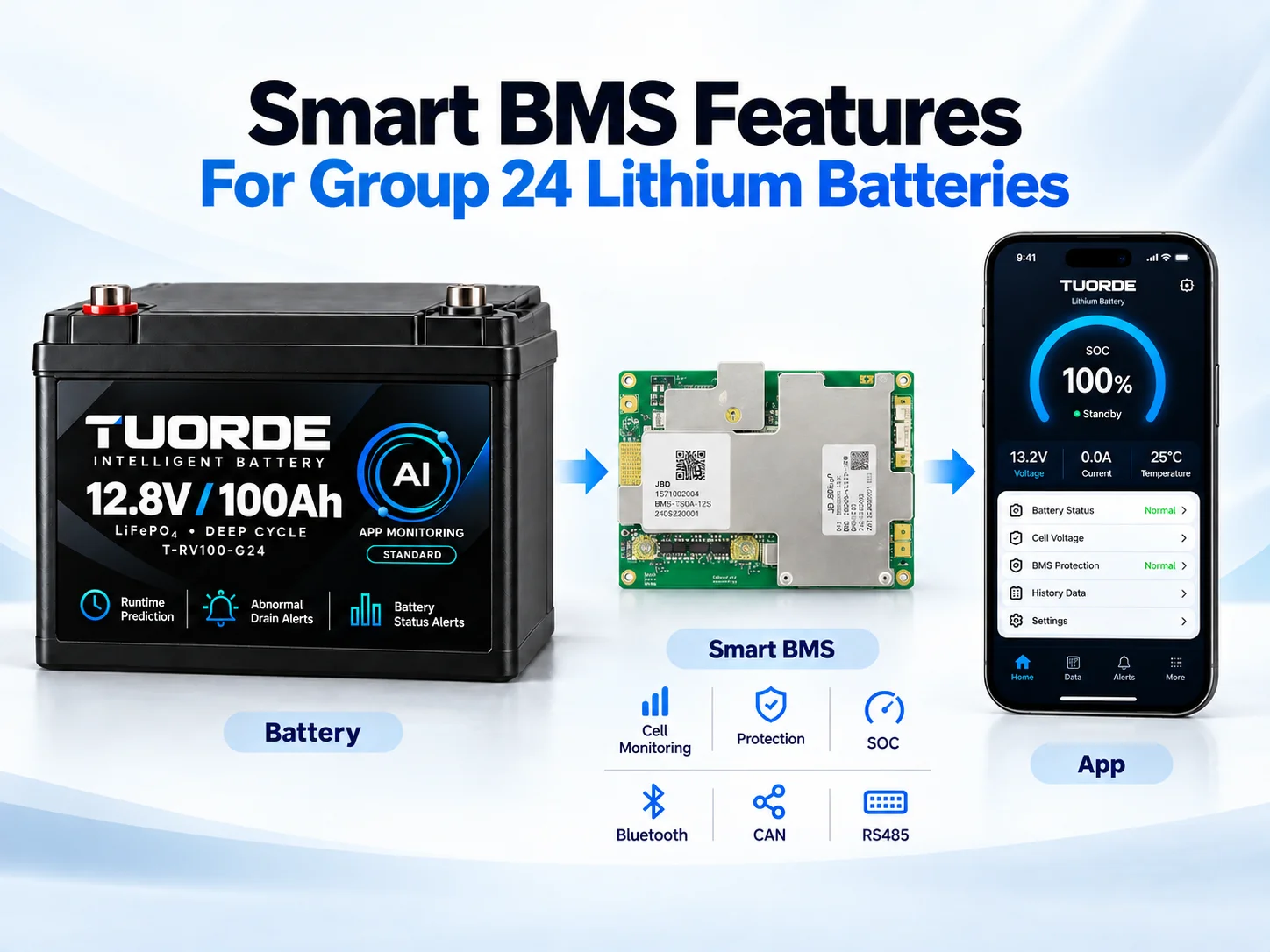
Optional Monitoring & Communication Features
View SOC, voltage, current and temperature through a compatible application.
Exchange battery information with equipment using a validated CAN protocol.
Connect supported system controllers and communication interfaces.
Review operating data and battery condition indicators.
Estimate operating time as connected loads and conditions change.
Smart BMS & AI RV Battery Technology
Configuration-dependent AI options include abnormal drain alerts and One-Tap Smart Troubleshooting alongside runtime and health insights. Guided diagnostics identify abnormal conditions and support troubleshooting; they do not perform physical battery repair. CAN and RS485 integrations require validation of the communication protocol and connected equipment.
The Group 24 format suits applications that need compact installation and reliable deep cycle energy, when the selected model meets the system requirements.
Compact house power for lights, ventilation and daily auxiliary loads.
A space-conscious energy option where the tray and electrical ratings match.
Deep cycle storage for campsite loads and solar-supported operation.
House energy for compatible marine installations; verify mounting, environmental suitability and charging.
These are house battery applications. Engine starting and high-current loads require separate model-specific confirmation.
A compact upgrade begins with the existing battery footprint and ends with a verified charging setup. Use this sequence to plan the replacement for your RV.
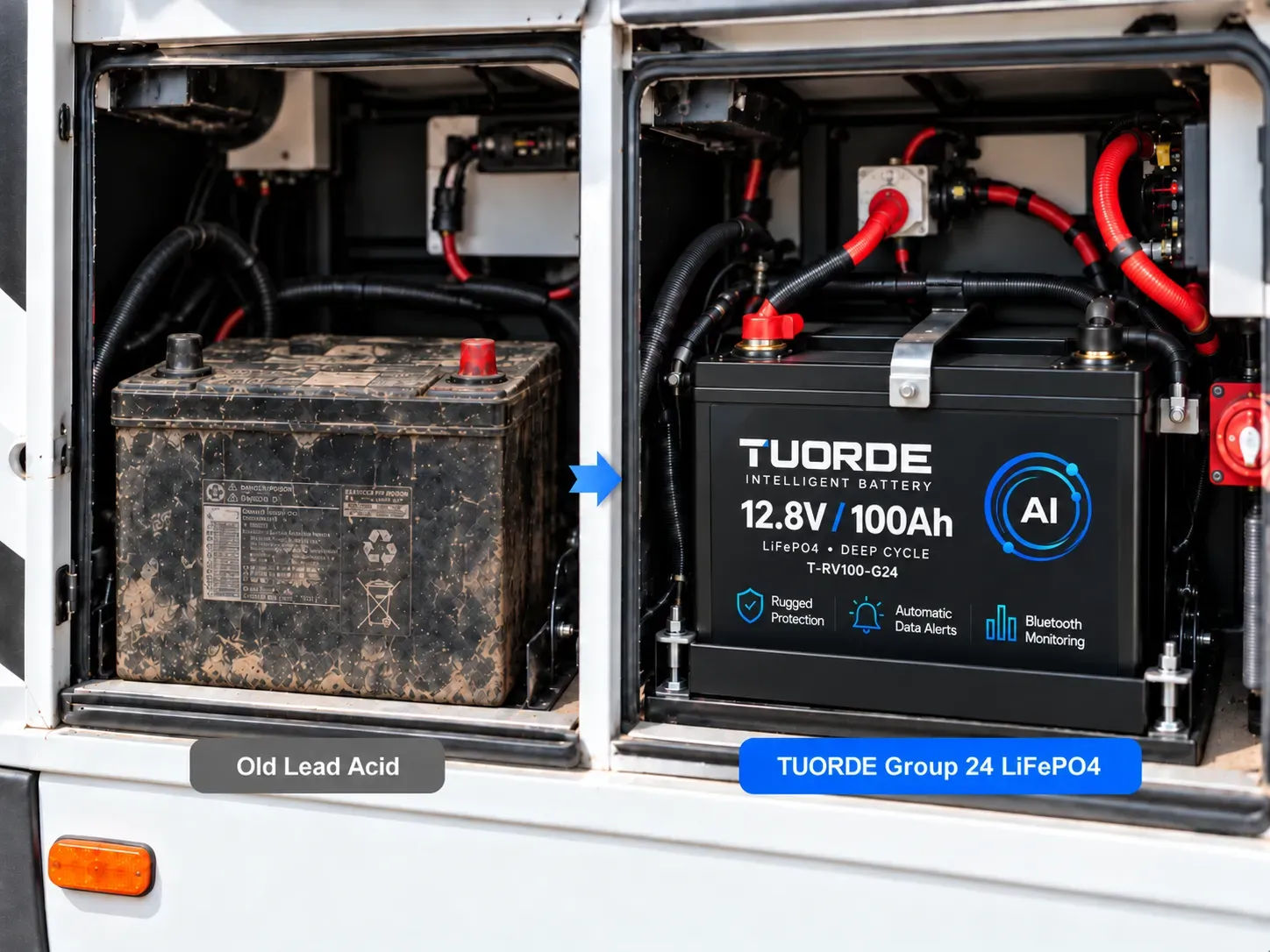
STAGE 01
Record tray dimensions, terminal polarity, cable condition and the charging equipment model.
STAGE 02
Secure the selected LiFePO4 battery and follow its instructions for terminal connections, cable size and fuse protection.
STAGE 03
Verify charging voltage, current limits, converter and solar settings, then check the intended loads.
For a complete charging-system review, read RV Lead Acid To Lithium Battery Replacement. Review available Battery Datasheets & Technical Resources, and request model-specific approved drawings before installation.
A Group 24 lithium battery is a LiFePO4 battery designed for installations commonly associated with the Group 24 battery format. Group size describes the physical fit reference; capacity, current limits and charging requirements depend on the specific battery model.
A compatible 12V LiFePO4 battery with the correct dimensions, terminal position and electrical ratings can replace a Group 24 RV house battery. A TUORDE 100Ah Group 24 reference configuration can be reviewed; confirm the approved model drawing, capacity and charging requirements before selection.
Many RV house battery systems can be upgraded after confirming battery fit, voltage, charger and converter settings, inverter loads, wiring and fuse protection. A lithium upgrade requires a system check rather than assuming every Group 24 battery is a direct replacement.
Group 24 does not define a fixed amp-hour capacity. TUORDE platform data includes a 100Ah Group 24 reference configuration; confirm the approved capacity and release status for the selected model. Choose capacity based on daily energy consumption and required runtime, then verify the dimensions and BMS current rating for the selected configuration.
A properly specified Group 24 LiFePO4 battery can suit small RVs and camper vans with limited installation space. Check whether its usable energy, discharge current and charging limits support your lights, appliances and inverter loads.
Yes, when the solar controller supports the battery’s LiFePO4 charging profile, voltage settings and current limits. Check the combined current from all charging sources and confirm low-temperature charging protection for the selected battery.
They need compatible charging settings. An existing charger may be suitable if its voltage, current and operating modes meet the battery specifications. Lead-acid equalization and desulfation modes should not be used; alternator charging may require a DC-DC charger.
Selected TUORDE Group 24 configurations support Bluetooth monitoring and CAN or RS485 communication options. Confirm the BMS, communication protocol, firmware, app functions and connected equipment compatibility before integration.
Choose TUORDE Group 24 LiFePO4 batteries for compact RV applications, deep cycle performance and intelligent energy management.
Share your tray dimensions, terminal polarity, DC and inverter loads, charging equipment, and initial and annual quantities for a Group 24 configuration review.