
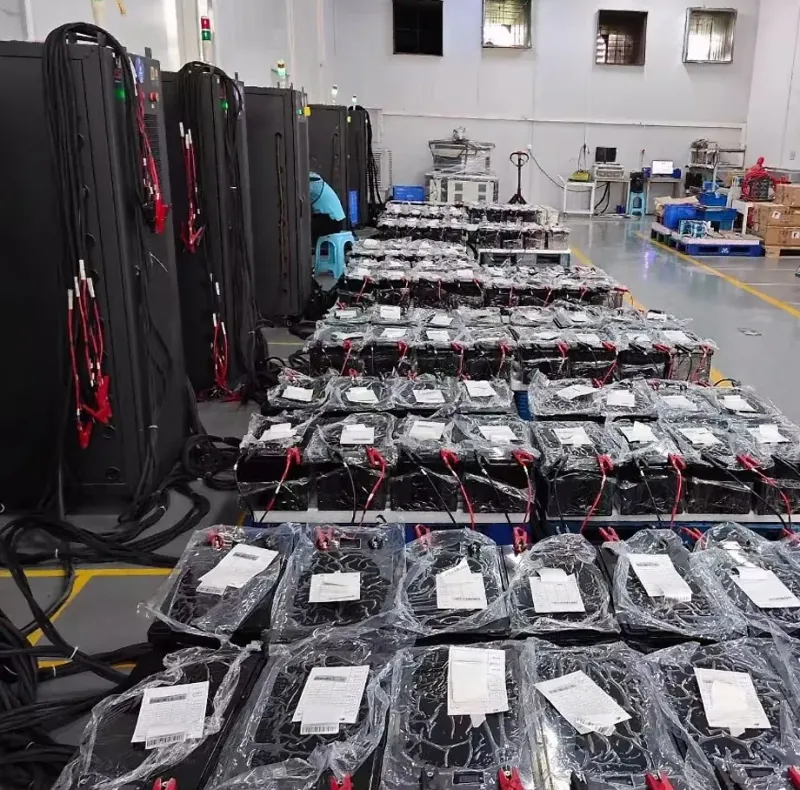
Cover photograph: TUORDE battery packs connected to workshop test equipment. This image does not establish the model, test conditions or results of an ST230 test.
TRUCK BATTERY ENGINEERING · ST230 APPLICATION REVIEW
Yes—a purpose-built 24V lithium battery can support both duties in a compatible truck. The question is whether it can still meet the engine’s starting requirement after the agreed parking load has been used. Amp-hours and a successful start with a full battery do not answer that question.
For a fleet running cabin cooling, a refrigerator and lighting, the useful acceptance test follows the working day: start, drive, park, run the auxiliary loads, then start again. It also checks what happens when temperature, charging time or load demand is less favorable than expected.
Starting needs power. Parking consumes energy.
The starter asks for high current over a short period while the vehicle needs sufficient voltage to crank and keep its controls operating. A refrigerator or cabin cooling system draws power for much longer. Some parking loads also have startup surges. These are different demands on the cells, BMS, connections and wiring.
A current figure without its duration and conditions is incomplete. Review the current trace, minimum voltage, battery temperature, initial state of charge and repeated-start sequence. A short peak-current specification is not a CCA rating, and neither a capacity label nor nominal kWh establishes compatibility with a particular engine.
What ST230 brings to a 24V truck project
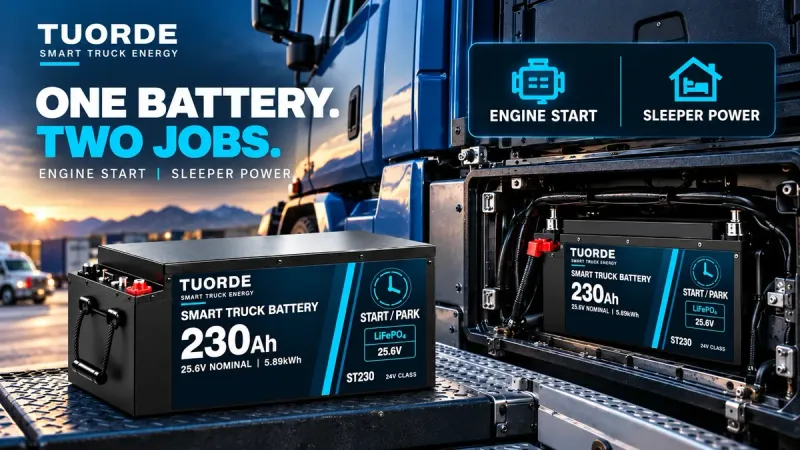
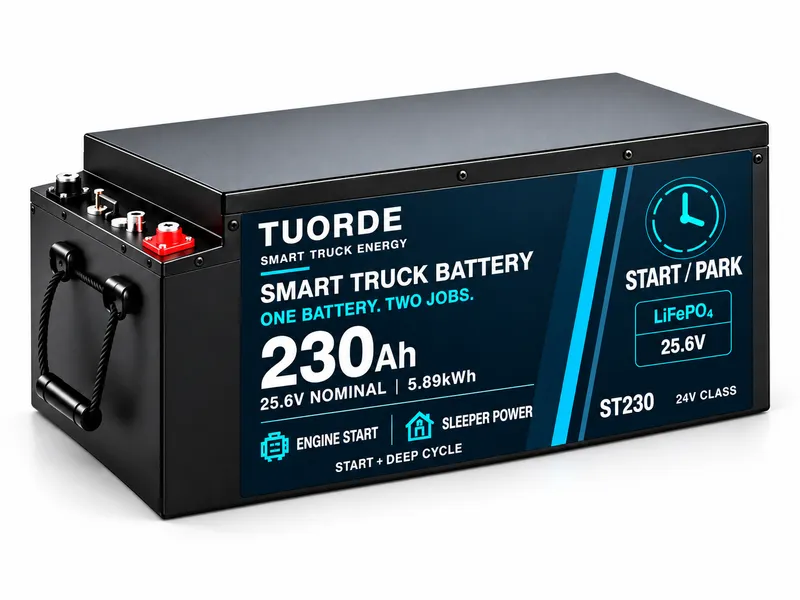
The TUORDE ST230 24V truck battery combines starting and parking duties in an 8S LiFePO4 platform. Its current product page lists 25.6V nominal voltage, 230Ah and 5.89kWh nominal energy, with 200A continuous charge and discharge ratings. These published ratings must be checked against the supplied revision and vehicle requirements.
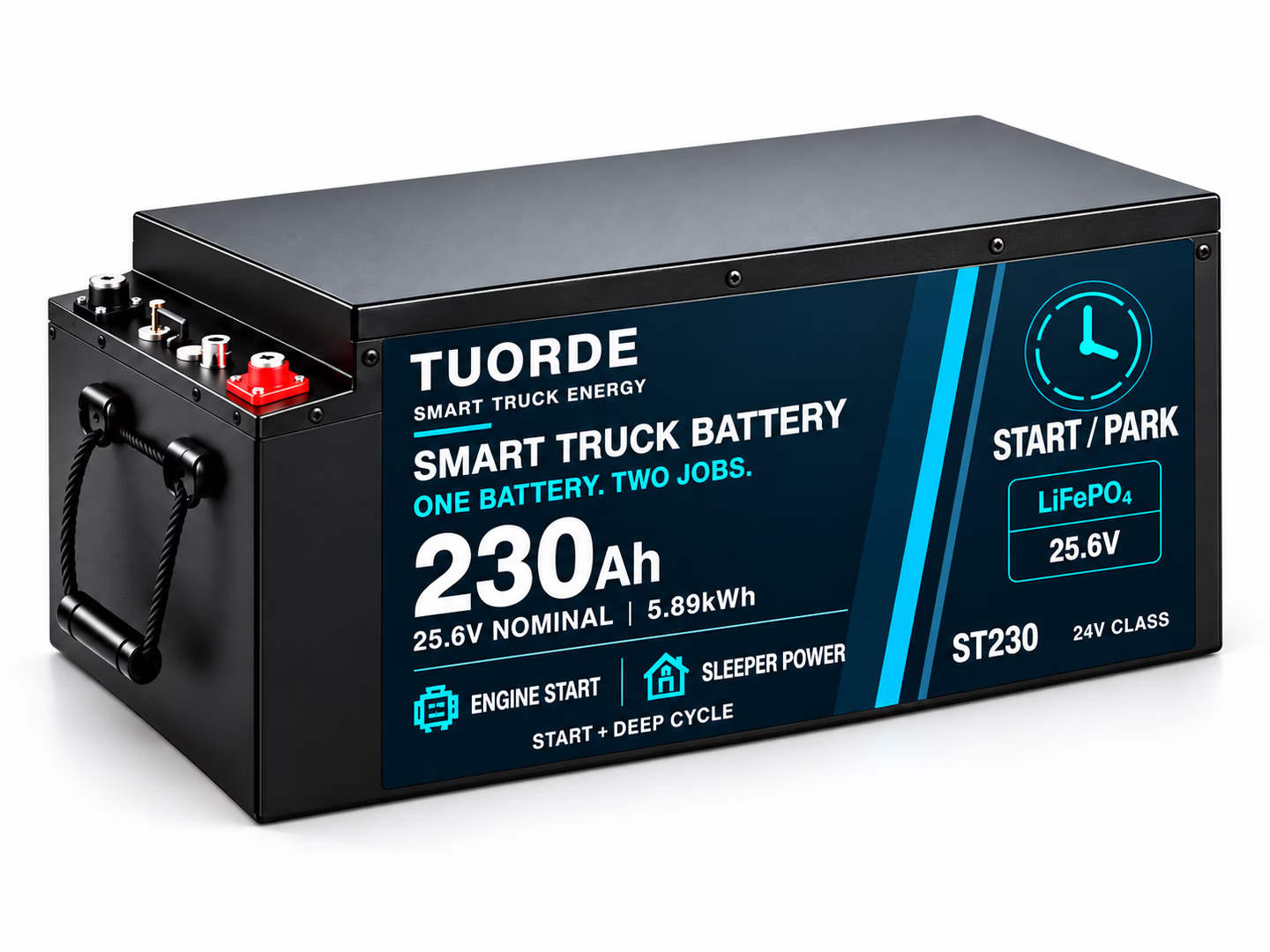
The energy calculation is 25.6V × 230Ah = 5,888Wh, rounded to 5.89kWh. That is nominal energy, not a guaranteed parking allowance. The operating window depends on protection limits, temperature, battery condition and the starting reserve; AC loads also involve inverter losses.
ST230’s product page describes a default 10% SOC starting reserve, subject to configuration. Treat it as a control setting to validate, not a promise of a morning restart. The vehicle must disconnect the intended auxiliary loads while retaining the starting path. Confirm which loads remain connected after the reserve threshold is reached.
The test that matters: parking followed by a restart
TUORDE confirms that ST230 has completed starting-current testing and parking-power deep-cycle testing. Original numerical test records, current curves and detailed conditions are not available for publication in this article. Separate completion statements do not demonstrate that your vehicle’s combined duty cycle has passed.
For sample acceptance, agree the limits before testing. Ask the engineering team to provide the model-specific records below and run the combined sequence for the intended vehicle configuration.
| Checkpoint | Record to request | Acceptance question |
|---|---|---|
| Starting event | Current and voltage versus time; temperature, initial SOC and start attempts | Does the complete event stay within the agreed vehicle and battery limits? |
| Parking duty | Measured battery-side load and energy log; load-switching and surge events | Can the agreed loads operate through the defined stop without an unexpected trip? |
| Reserve and restart | Auxiliary-load cutoff, remaining loads and restart trace after parking | Is the reserve retained, and does the subsequent start meet the agreed limits? |
| Recharge | Battery-side charging log with active vehicle loads and route conditions | Can the available driving or charging window restore the required energy? |
| Cold operation and recovery | Temperature, heating state, protection events and permitted recovery sequence | Do charging, load control and restart behavior follow the approved instructions? |
A useful report identifies the battery serial number, BMS hardware and firmware, settings, instruments and measurement points. Keep those identifiers with the sample approval. If production changes affect the accepted behavior, agree how the change will be reviewed and verified.
Shared lead-acid bank, separate banks or one dual-purpose pack?
There is no layout that wins every truck program. Start with the existing wiring and service requirements rather than assuming fewer batteries always means a better installation.
- A shared lead-acid bank: starting and auxiliary loads draw from the same bank. Its remaining starting capability still depends on the discharge history and conditions; the existing layout is not proof that its parking allowance is adequate.
- Separate starting and auxiliary banks: a properly designed arrangement can isolate parking consumption from the starter bank. It also needs space, charging distribution, isolation and service procedures for both banks.
- One starting-and-parking lithium pack: combines the duties in one pack, with reserve and load-control requirements designed together. A pack-level fault can affect both functions, so the vehicle’s recovery plan and service access matter.
Compare the Truck Starting & Parking Battery Solutions against your architecture. A general deep-cycle lithium pack should not be substituted into a starter circuit merely because its voltage and capacity look suitable.
Charging and fit can decide the project
Review the alternator, voltage-control strategy, battery sensors and any external charger with the vehicle integrator. ST230’s listed 200A charging limit is a battery limit—not evidence that the truck will deliver that current. Measure net energy reaching the battery while other loads are running. For a charging fault investigation, use the 24V truck charging checklist.
ST230’s published enclosure is 470 × 290 × 235mm and its listed weight is 47kg. Check the current drawing, tray rating, restraints, terminal access, cable reach and service clearance. Qualified installers should review the starter and auxiliary protection paths separately. Do not assume universal drop-in compatibility or unapproved series/parallel connections.
Cold-weather review must cover charging permission as well as starting. ST230 supports 4G heating commands subject to the installed hardware, network service and operating conditions. A remote command does not prove that the cells have reached an approved temperature. Obtain the delivered configuration’s heating and charging instructions.
Questions procurement should settle before ordering
Will ST230 run my air conditioner all night?
A 230Ah label cannot answer that. Send a measured battery-side load log, stop duration, temperature requirements and reserve strategy. Validate the restart after that parking duty; do not rely on an unspecified runtime claim.
Can we evaluate samples before a production order?
Request sample availability, configuration, commercial terms and a written acceptance plan. Agree which tests TUORDE supplies and which vehicle-level checks your integration team performs.
What are the MOQ and private-label options?
Ask for a project quotation. Minimum quantities, pricing and lead time depend on the agreed scope. Use the OEM/ODM battery project review to define branding, packaging, BMS settings and required interfaces rather than assuming every option is standard.
What technical support and warranty apply?
Request the documents for the exact model, configuration and order. Keep the serial number, installation details and BMS logs for troubleshooting. The Support & Warranty process explains what information to send.
Bring the vehicle duty—not just the Ah target
Send the truck and engine model, starter current/time requirement, minimum voltage and temperature, parking-load log, recharge window, charging equipment, tray drawing and expected sample and annual quantities. Flag anything that is still an estimate.
In your inquiry, mention “ST230 starting and parking review” so the project context is clear.
Technical basis: current ST230 product information and TUORDE Truck Solutions, reviewed October 31, 2026; test-completion status confirmed by TUORDE. The matrix is a proposed acceptance checklist, not a published test result. Request the controlled datasheet, installation instructions and original model-specific test records for engineering approval.