
On October 14, 2026, the U.S. Department of Transportation announced $200 million for 14 truck-parking projects in 12 states. The funding is for parking infrastructure, not batteries. Still, it puts a familiar fleet question back on the table: when the engine is off for the night, what powers the sleeper cab—and what ensures the truck starts the next morning?
There is no single answer for every route. The U.S. Department of Energy's idle-reduction guide describes auxiliary power units, battery-electric cooling and electrified parking, among other approaches. For an OEM or fleet evaluating onboard storage, the first job is to measure the actual duty cycle.
Start with the overnight load, not the battery size
A refrigerator, ventilation, lighting, communications and an inverter may all draw power while parked. A nameplate wattage alone does not reveal the energy used overnight: refrigeration cycles, inverter standby consumption and the weather change the result. Climate control deserves its own measured profile.
Here is a hypothetical stop to show the arithmetic, not a TUORDE test or runtime promise:
- Refrigeration and ventilation: 90W average × 10 hours = 900Wh.
- Lighting and communications: 45W × 8 hours = 360Wh.
- AC equipment through an inverter: 300W × 2 hours ÷ an assumed 90% efficiency ≈ 667Wh at the battery.
- Inverter standby: 15W × 10 hours = 150Wh.
That adds up to about 2.08kWh at the battery, before other loads and any energy reserved for starting. A measured hot-night air-conditioning load could change the picture substantially.
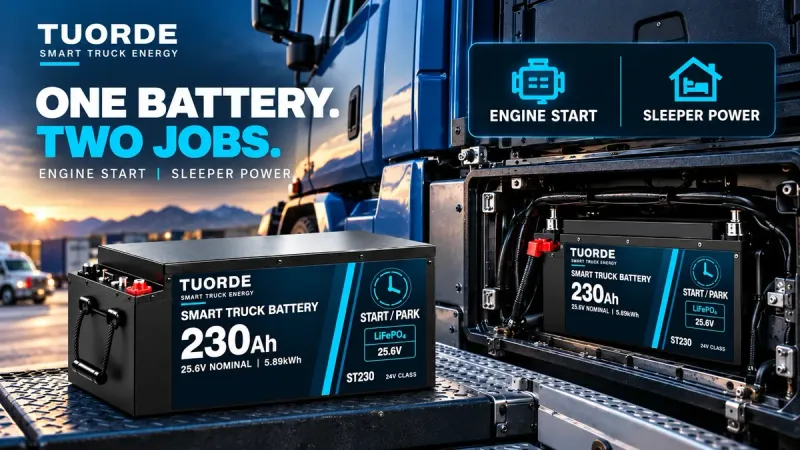
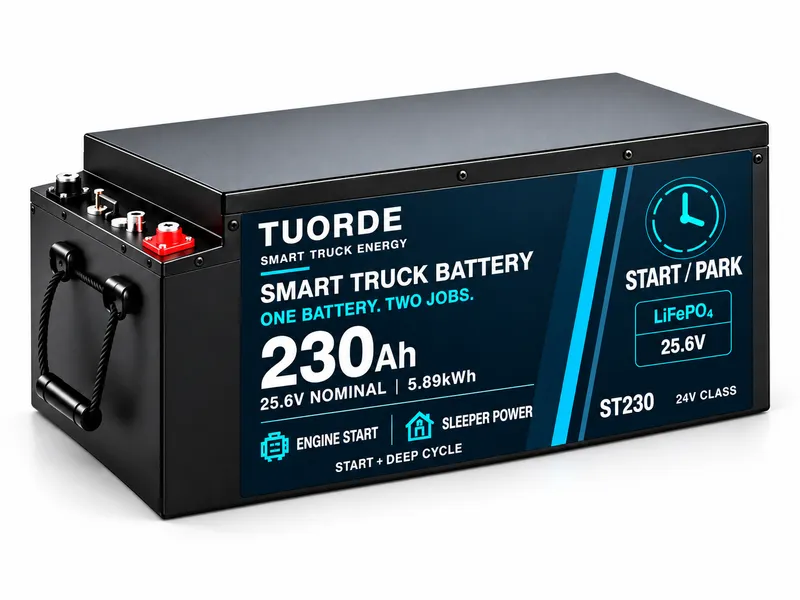
The TUORDE ST230 is listed at 25.6V, 230Ah and 5.89kWh nominal energy. That last figure is a rating, not a promise that 5.89kWh is available for hotel loads. Temperature, conversion losses, protection settings and the starting reserve determine the usable window for a particular vehicle.
Keep starting separate from parking
The ST230 product page lists a default 10% state-of-charge starting reserve, subject to the ordered configuration. It can limit normal parked-load discharge, but it does not itself prove that a cold engine will crank. The vehicle's load isolation and restart strategy must work with the reserve setting.
Likewise, the listed 1,200A for one second is a time-limited peak-current rating, not a CCA rating. Battery Council International's CCA definition uses specified cold-temperature and duration conditions. Ask for the actual starter current trace, minimum voltage, ambient temperature and repeat-start requirement; review test evidence for the exact battery configuration.
Can the truck replace what it used overnight?
The route matters as much as the overnight stop. If a vehicle used the illustrative 2.08kWh, a hypothetical net charging rate of 0.70kW at the battery would take about three hours just to replace that energy, before charge taper and additional losses. This is arithmetic, not an ST230 charging result. Short driving windows, auxiliary loads running during the drive and alternator controls can all extend the time.
Before selecting a pack, confirm the alternator and charge-control arrangement, charging voltage and current limits, and the hours available between stops. A larger Ah number will not fix a system that routinely cannot recharge.
A useful project brief fits on one page
For a model-specific review, send TUORDE the truck and engine model, existing battery arrangement, starter current and temperature requirements, a measured parked-load log, the longest expected stop, and the usual driving time before the next stop. Add the alternator or charger details and a compartment drawing with tray, terminal, cable and hold-down clearances.
For ST230, the public page lists a 470 × 290 × 235mm enclosure, 47kg weight and 200A continuous charge/discharge ratings. Confirm those against the ordered revision and check cables, external protection, charging behavior and BMS configuration as part of the vehicle system. Remote heating, monitoring and communication options also depend on the selected hardware and software.
Compare the TUORDE truck starting and parking platforms, then check the available model documents. If your fleet has an overnight load log and a starting requirement, talk to TUORDE battery engineers about the configuration to validate.
Sources: U.S. Department of Transportation truck-parking announcement (October 14, 2026); U.S. Department of Energy Alternative Fuels Data Center idle-reduction equipment guide; Battery Council International glossary; TUORDE ST230 public product page. Example load and recharge figures are illustrative calculations.