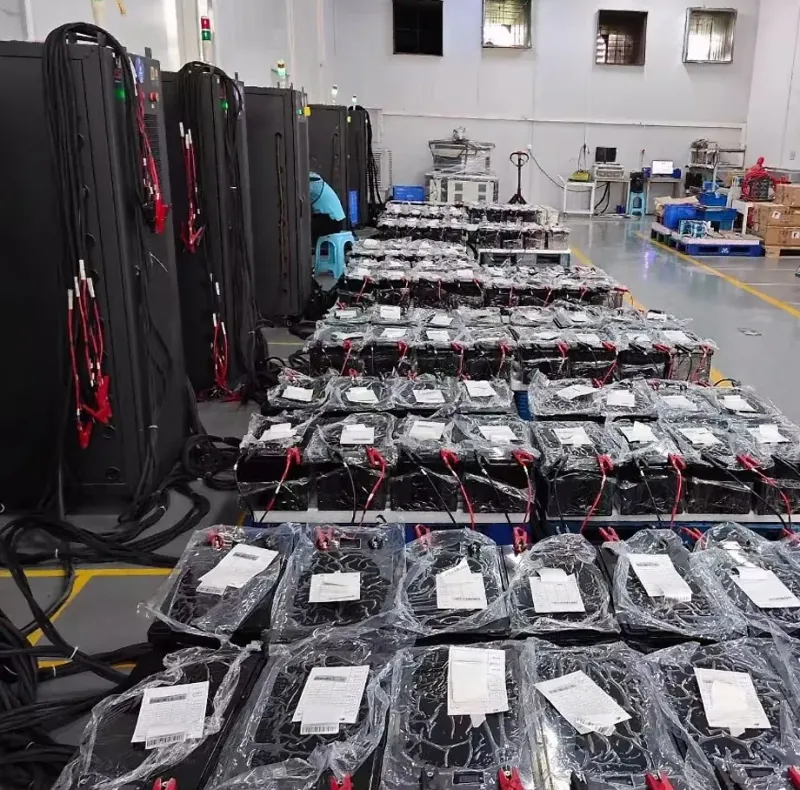

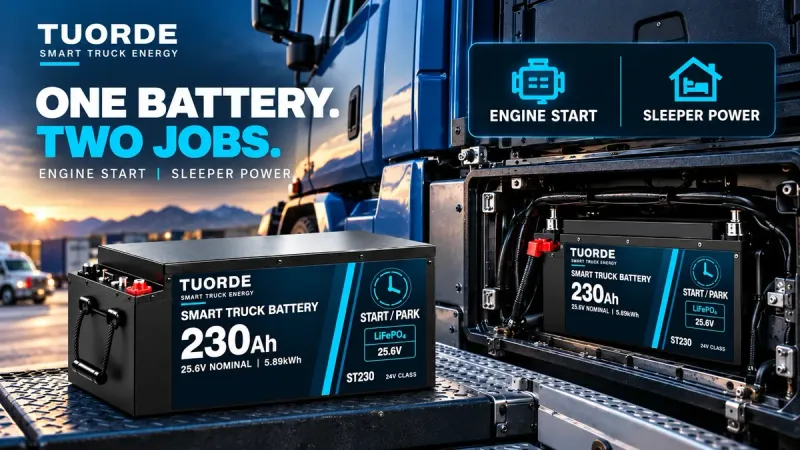
Cover image: application illustration; not model-specific installation or test evidence.
TRUCK STARTING & PARKING
Specify engine starting and parking power as two separate duties, then check them together against the vehicle’s charging and installation requirements. A battery with enough amp-hours for overnight loads is not automatically able to crank an engine. A battery that starts the engine once may not provide the required parking energy or recover that energy during the available driving window.
This workflow is for commercial vehicle manufacturers, upfitters, fleet suppliers and distributors evaluating a 24V starting-and-parking project. It is a procurement and integration brief, not permission to fit a general deep-cycle battery into a starter circuit.
1. Record the vehicle and existing battery arrangement
- Vehicle make, model, year and electrical system voltage; engine model, displacement and starter identification.
- Existing battery chemistry, quantity, series/parallel arrangement, rating labels and wiring diagram. Include clear terminal and tray photographs.
- Alternator model, rated output, voltage-control strategy, battery sensors, isolators and auxiliary charging equipment.
- Minimum expected battery temperature, starting frequency, parking duration and any vehicle manufacturer restrictions.
Identify whether starting and auxiliary loads currently share one bank or use separate banks. A change in battery chemistry can affect monitoring, charge control and protection behavior. Ask the vehicle manufacturer or integration partner what must remain unchanged before choosing a replacement architecture.
2. Describe starting demand as a testable event
Request a current-versus-time requirement, minimum acceptable voltage at the relevant measurement point, battery temperature, initial state of charge and repeat-start sequence. State whether results are from a vehicle measurement, a starter specification or a defined laboratory load. These are different kinds of evidence.
Cranking labels must retain their test method. ODYSSEY’s manufacturer FAQ, for example, distinguishes cold-cranking and marine-cranking ratings by their test temperatures. A short pulse-current figure cannot simply be renamed CCA. This distinction does not assign an ODYSSEY rating or test result to a TUORDE battery.
| Duty | Information to agree | Selection decision |
|---|---|---|
| Engine start | Current/time profile, minimum voltage, temperature, initial SOC and repeated attempts | Match the exact starting event and protection behavior. |
| Parking power | Battery-side load profile, operating hours and permitted energy window | Determine the energy needed while retaining the agreed starting reserve. |
| Recharge | Charging equipment, available time, active loads and approved limits | Check whether the duty cycle can replace the energy consumed. |
3. Build a parking-load schedule and reserve strategy
List each cooler, refrigerator, light, inverter and accessory separately. Record average consumption, startup events, hours of use and whether values are measured on the DC or AC side. Convert AC demand using the inverter’s relevant efficiency and include standby consumption. Do not count a thermostat-controlled load as running continuously unless that is your intended assumption.
Agree what “starting reserve” means in this vehicle: energy held back, a load-disconnect strategy, recovery conditions and the starting performance that must remain after parking. An SOC threshold alone is not proof of a successful cold start. Compare parking demand with the approved usable operating window rather than nominal kWh alone.
4. Check recharge, fit and protection as one system
Provide the driving and external-charging windows, measured charging behavior and loads that remain active during charging. If daily replenishment is below daily consumption, a larger battery alone does not solve the imbalance. Review the charging architecture and its control requirements with the vehicle integrator.
- Measure tray length, width, height and service clearance; confirm hold-down method, orientation, mass allowance and vibration requirements.
- Check terminal type and position, cable reach, connection torque instructions and access for maintenance.
- Agree cable, fuse, switching and isolation requirements for starter and auxiliary paths separately. A protection device in the wrong path can interrupt a required start.
- Define what happens after low voltage, overcurrent or a temperature event, including vehicle monitoring and reconnection.
5. Turn the information into a model-specific review
Send the vehicle brief, load schedule, current/time evidence, charging details and tray drawing together. Ask for a proposed model and revision, remaining assumptions, integration changes and a sample validation plan. Approve representative starting, parking, recharge and recovery tests before releasing the configuration for production.
Use the existing Truck Starting & Parking Battery Selection Overview for the available platforms, and Technical Datasheets & Downloads for model documents. Requirements remain specific to the ordered battery and vehicle.
Sources and application limits
The official documents below support the technical distinctions discussed here. Their product-specific limits and settings belong to those manufacturers; they are not TUORDE specifications. Use the current manual, approved battery datasheet and project drawing for the actual equipment combination.
- ODYSSEY Battery — Frequently Asked Questions: cranking rating definitions
- Victron Energy — Lithium Smart Battery Manual
Talk to Battery Engineers
Send the vehicle and engine details, starting current/time requirement, parking-load schedule, minimum temperature, charging equipment, installation drawing and expected quantity. Identify any information that is still an estimate.
Talk to Battery Engineers