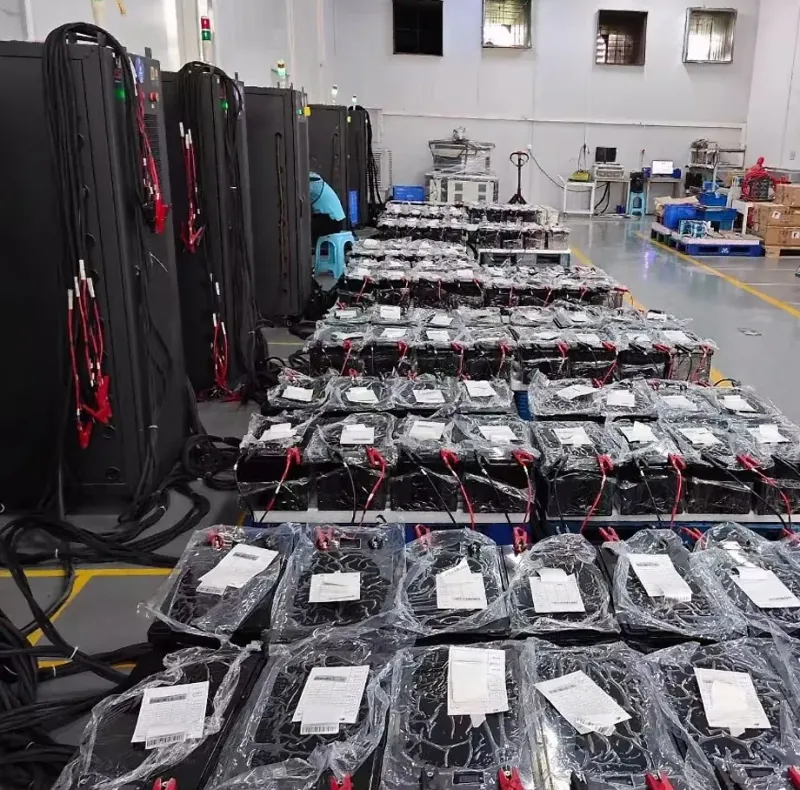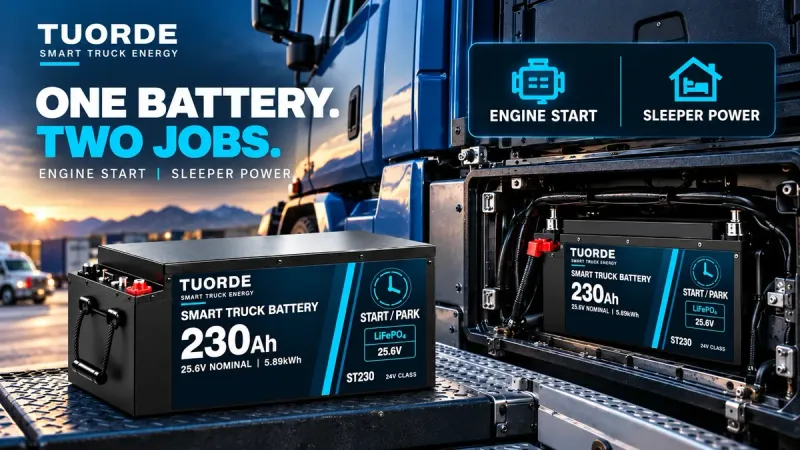

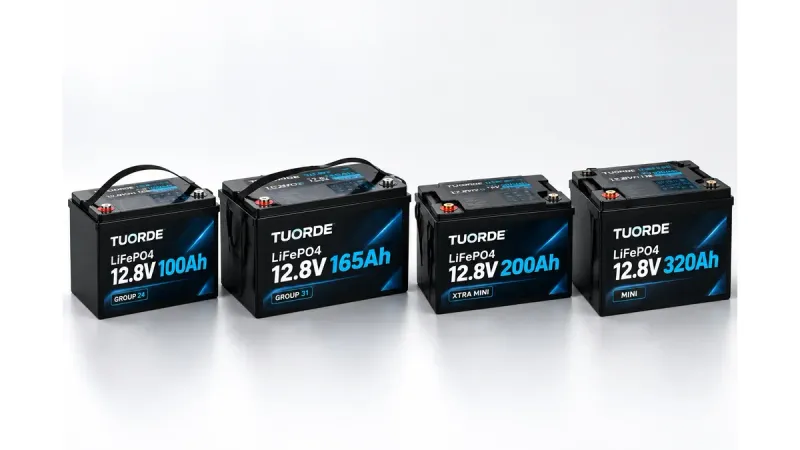
Cover image: application illustration; not model-specific installation or test evidence.
OEM & BATTERY ENGINEERING
A useful OEM lithium battery RFQ defines the application, duty, interfaces and acceptance criteria—not just voltage, capacity and a logo. Give suppliers enough information to identify a suitable platform, expose unresolved assumptions and quote the same scope. Mark unknowns clearly rather than filling them with unverified targets.
This checklist is for vehicle manufacturers, battery brands, distributors and system integrators preparing an OEM or private-label program. It can support an initial platform assessment or a custom development brief. It does not establish a fixed MOQ, sample lead time, certification package or production schedule.
1. Define the duty before the enclosure
Describe the application and electrical architecture: RV house storage, truck starting and parking, an auxiliary system or another defined duty. State the nominal system class and the permitted operating voltage window of connected equipment. Identify whether the battery is part of a new design or a replacement in an existing installation.
Provide required Ah and Wh if known, but also explain the load schedule, desired runtime and usable-energy assumptions. Record sustained charge/discharge demand and peak events separately, including duration, repetition, temperature and minimum voltage. Engine-starting requirements need their own evidence; an inverter surge specification is not an equivalent substitute.
2. Describe mechanical, environmental and interface requirements
| Requirement group | Information to include | Why it improves the quotation |
|---|---|---|
| Mechanical | Maximum envelope, drawing, mounting, orientation, terminal type/location, cable clearance and mass limits | Distinguishes an existing enclosure option from mechanical development. |
| Environment | Charge/discharge/storage temperature, water/dust exposure, vibration, condensation and installation location | Identifies operating constraints and the validation work to agree. |
| Charging | Equipment models, profiles, current limits, sensing and alternator architecture | Defines integration work and avoids unsupported compatibility assumptions. |
| Communication | CAN/RS485 protocol, connector, pinout, speed, host model/firmware and required messages; Bluetooth/App functions | Separates a physical interface from a verified communication implementation. |
For CAN or RS485, attach the host protocol document and identify the party responsible for integration. A port name alone does not establish message compatibility. For Bluetooth or an App, define the visible data, alarms, branding, languages, account requirements and any software-maintenance expectations. Confirm which functions are supported on the proposed hardware and firmware.
3. Specify market documents and private-label deliverables
List the destination markets, application and transport modes. Identify requested test reports, declarations and labels with their required scope, and ask the supplier to confirm applicability to the exact battery design and revision. Do not treat a cell report as automatic coverage for a finished pack or assume one document answers every market requirement.
PHMSA’s lithium-battery guidance and test-summary resources explain the role of transport design testing and traceable test summaries. A transport document does not by itself establish suitability for an RV, truck or other end-use installation. Agree any additional product/system requirements with the relevant integrator and compliance specialists.
Provide editable logo artwork, model naming, label and carton requirements, manual languages, accessory list and any App-branding scope. State whether the quoted package must include drawings, charging instructions, communication documentation, inspection records and agreed traceability information.
4. Agree validation and the commercial assumptions
Share the estimated sample quantity, annual volume, order pattern, target milestones and delivery destination. Distinguish forecasts from committed orders. Ask the supplier to identify development charges, tooling, sample scope, MOQ assumptions, production lead time assumptions and delivery terms in its quotation rather than assuming a universal policy.
Define the sample test setup and who will evaluate fit, load behavior, charging, temperature protection, communication and recovery. Agree pass/fail criteria and how design changes will be recorded. Production approval should reference the accepted battery revision, drawings, artwork, operating limits and inspection scope. Changes after validation may require additional review.
Copy this RFQ information checklist
Project/company and technical contact:
Application, vehicle/equipment and new design or replacement:
System voltage and connected equipment operating window:
Capacity/energy target, load schedule and required runtime:
Continuous charge/discharge current and conditions:
Peak/start/surge current, duration, repetition and minimum voltage:
Temperature range and installation environment:
Maximum dimensions, drawing, mounting and terminal layout:
Charger/converter/solar/alternator equipment and settings:
CAN/RS485 protocol, host model/firmware and connectors:
Bluetooth/App data, alarms, languages and branding scope:
Target markets, transport modes and required documents:
Logo, labels, packaging, accessories and manual languages:
Sample quantity, validation setup and acceptance criteria:
Estimated order/annual quantity and target project milestones:
Delivery location/terms and quotation assumptions to clarify:
Attached drawings, label photos, manuals, load logs and protocols:
Unknown items and who will confirm them:
Send supporting evidence with the RFQ
A compartment drawing, existing battery label, equipment manuals, measured load log and host protocol usually resolve more questions than a broad “drop-in” request. Use the Battery Guides hub to organize selection checks and OEM & Private Label Solutions to discuss program scope. Request model-specific documents through Technical Datasheets & Downloads.
Sources and application limits
The official documents below support the technical distinctions discussed here. Their product-specific limits and settings belong to those manufacturers; they are not TUORDE specifications. Use the current manual, approved battery datasheet and project drawing for the actual equipment combination.
Talk to Battery Engineers
Send the completed checklist with drawings, load information, equipment manuals and protocol requirements. Identify mandatory requirements, preferences and open items so the proposed configuration and quotation can address the same project scope.
Talk to Battery Engineers