
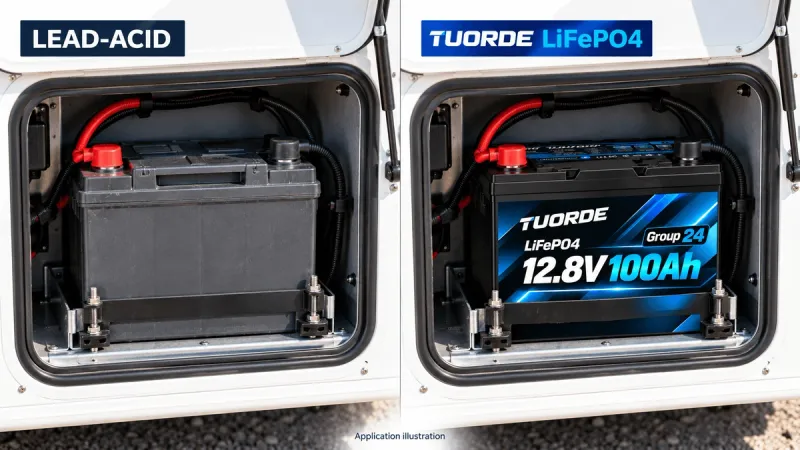
Cover image: application illustration; not model-specific installation or test evidence.
RV LITHIUM & UPGRADES
Your existing RV converter may be suitable, may need a documented setting change, or may need replacement. Decide from the exact converter manual and the selected battery’s approved charging requirements. A “12V” label or the fact that the unit produces charging current does not establish LiFePO4 compatibility.
This review is intended for RV manufacturers, retrofit installers and dealers planning a house-battery upgrade. It covers the shore-power or generator-fed AC-to-DC converter. Solar and alternator charging are separate paths that need their own checks.
1. Identify the installed converter, not just the power-center brand
Photograph the converter’s rating plate and note its model suffix, serial number, hardware revision and any lithium-mode switch or indicator. If it is inside a power center, identify the actual converter section as well as the enclosure model. Use the equipment manufacturer’s official support page to obtain the matching manual; a visually similar model can have different charge logic.
Record the battery model and revision being proposed. Obtain its permitted charging voltage range, charge-current limit, temperature conditions and any required charger-enable interface. Keep recommended charging settings separate from absolute protection limits.
2. Compare the complete charge behavior
| Check | Evidence to record | What must agree |
|---|---|---|
| Chemistry and mode | Selected profile, switch/indicator state, firmware or model revision | The documented mode is appropriate for the exact battery. |
| Voltage behavior | Charge stages, setpoints, stage duration and restart logic | Every normal charging stage stays within approved battery requirements. |
| Current | Maximum converter output, adjustable limit and other active DC loads | Battery current and the combined contribution of all chargers remain permitted. |
| Special functions | Equalization, desulfation, storage and temperature-compensation behavior | Disable or configure functions only as the equipment and battery manuals require. |
| Temperature and control | Battery charge-temperature limits, sensing and charger-enable method | The system can inhibit charging under the required conditions. |
| Installation | Conductors, protection, ventilation and voltage drop | The existing installation supports the approved operating current. |
Progressive Dynamics documents different profile-selection methods across its PD4100 and PD9300 families. WFCO provides model-specific operating and troubleshooting guidance for its AD power centers. These examples demonstrate why the exact manual matters; they do not establish compatibility with a particular TUORDE battery or supply a universal charge-voltage setting.
3. Review lead-acid functions by their actual behavior
Do not decide from a feature name alone. Find out what an equalization or desulfation routine actually does: voltage, duration, repetition and whether it operates in the selected mode. If that behavior conflicts with the battery’s approved requirements and cannot be disabled by a supported procedure, the combination needs a different charging solution.
Check temperature compensation independently from cold-charge protection. A function that changes charging voltage with ambient temperature is not the same as a battery-temperature limit that stops charging. Victron’s Lithium Smart manual contains charger-setting guidance for its own batteries, including temperature-compensation treatment. Use TUORDE’s selected-model instructions for a TUORDE installation, rather than copying another manufacturer’s settings.
4. Trace all three charging paths
- AC converter: powered from shore AC or a generator; it may supply house loads while charging the battery.
- Solar controller: has its own charge profile, limits, sensing and temperature settings. A correct converter setting does not correct an unsuitable solar setting.
- Alternator path: may involve direct vehicle wiring, an isolator or DC–DC charger. Review voltage control, current limiting and vehicle integration separately.
Consider simultaneous charging. The battery sees the combined current reaching it after active loads, not just one charger’s nameplate. Ask the installer to document the expected operating cases and protection response. Do not bypass BMS protection to force a charging source to continue.
5. Use a practical installer sign-off
- Record converter and battery model/revision, manual references and selected operating mode.
- List the approved battery settings beside the actual converter settings; flag fixed or unknown values.
- Confirm special-function and temperature behavior for every charging source.
- Check installation condition, protection coordination and cable voltage drop using the relevant manuals.
- Have a qualified installer verify the charging sequence, current, battery-terminal voltage and response to permitted control/temperature conditions. Follow manufacturer isolation procedures before service.
- Record the result as retain, reconfigure or replace, with unresolved items and the responsible reviewer.
Retain existing equipment when its documented behavior and installation meet the approved battery requirements. Reconfigure it when the manufacturer supports an appropriate mode or adjustment. Consider replacement when an essential requirement cannot be met; uncertainty should be resolved before installation, not treated as compatibility.
Continue with the RV Lithium Battery Compatibility Guide and RV Lead-Acid to Lithium Conversion Guide. Request the selected battery’s current datasheet and engineering documents before final approval.
Sources and application limits
The official documents below support the technical distinctions discussed here. Their product-specific limits and settings belong to those manufacturers; they are not TUORDE specifications. Use the current manual, approved battery datasheet and project drawing for the actual equipment combination.
- Progressive Dynamics — PD4100 Installation and Operation Guide
- Progressive Dynamics — PD9300 Series Manual
- WFCO — WF-8900-AD Series Manual, March 2024
- Victron Energy — Lithium Smart Battery Manual
Talk to Battery Engineers
Share converter label photos and its manual, the proposed battery model, solar and alternator equipment, existing settings, installation photographs and operating temperatures. We can review the battery requirements alongside your installer’s equipment assessment.
Talk to Battery Engineers